Monday, March 18, 2024

TIME FOR SENIORS TO 'THINK OUTSIDE THE CASKET'

Take the initiative to explore new horizons and never let our age stop us from trying new things that interest us.

Old age creeps up on us, and seems to speed up after we have passed the 70th milestone.

One fine morning, we wake up, look in the mirror and reality hits us literally in the face – we are no longer spring chicks, more like autumn turkeys! Where have all those years gone?

The thought of mortality is always there, unexpressed but silently acknowledged. Until the first signs of aches and pain remind us the clock is ticking away.

How do we want to spend our remaining years? By slowing down, by giving up fun activities for more serious ones as befitting our age, and according to society’s playbook? If this is what makes us happy and gives us peace of mind, by all means, go ahead.

But if in our hearts we want to sing, dance and celebrate life, and we are still able to do so, let’s just do it! Let’s break free from the shackles of social stigmas or self-imposed restrictions that are holding us back.

We all need a wake-up call sometimes before it’s too late and we are staring at Death from a hospital bed. Do we want to spend the rest of our lives merely existing instead of living?

The fastest way to speed up the ageing process is to think we are old and ready to die. We all have to die one day, but that shouldn’t stop us from having fun, adventure, romance and happiness while we still draw breath.

Live with no regrets

We’ve heard it before: 60 is the new 40 and 70 the new 50. Yet, there are many among us senior citizens who view themselves as 60 going on 80, and 70 going on 90. They think old, look old and act old. No wonder they feel they already have one foot in the grave.

We are not sixteen going on seventeen with a whole life ahead of us. Rather, we are heading towards the boarding gate for final departure. Let’s board with bagsful of happy memories, not regrets.

When we think we are old, we are. Our thoughts are very powerful. They govern how we behave and react. Upon reaching 60, there are those among us who retire not just from our jobs, but from everything that used to define who they are.

The first thing they give up is their physical appearance. In their minds, they are thinking – at my age, nobody gives me a second look, so why spend hard-earned money on unnecessary grooming.

Or they think they have been married for years, there’s no need to look good for their spouse. Their wardrobe consists mainly of auntie or uncle-type clothes in various funereal shades of black, brown and grey. If comfort is the reason, fine. But if they dress or act to please others, they are allowing others to dictate how they should be living their golden years.

Just going out, mixing with like-minded friends, learning a new skill will lift the spirits as we age. - PHILIPPE LEONE/Unsplash

Be true to yourself. Let others criticise all they want.

The men withdraw from social life, preferring to remain at home watching football on TV or hang out at the kopitiam or club with their buddies, discussing their favourite subject – politics and the state of the economy.

Few would consider taking up a new skill or activity to keep their minds sharp or join an outdoors group for some exercise. For the women, their stock answer to invitations to go out and enjoy themselves at a karaoke lounge, for example, is ‘Aiyah, old already, cannot sing!’

If you really love to sing and it makes you happy, don’t give it up just because you think you can’t sing anymore due to ‘old age’. You are suppressing the inner voice that is yearning to come out.

Many retirees allow themselves to go downhill upon retirement. They put on weight by avoiding all manner of physical activity. Their excuse – oh, at my age, I shouldn’t exert myself too much. Over time, they build up a host of health problems like high blood pressure, diabetes and heart disease.

They become frail and sickly, and dependent on others. They shun any form of physical exertion for fear of falling or hurting themselves. No one is suggesting they do marathons, climb mountains or shoot rapids.

Regular simple exercise such as daily brisk walking, stretching, and strength training is sufficient to ensure we remain fit in our senior years. Yet they make no effort to do so, and give a dozen reasons or excuses why.

Oftentimes the most painful (and expensive) lesson learned is when we have recovered from a major surgery or a near-death experience. That is the most effective motivator to get us to embark on a healthy lifestyle.

But why wait for that to happen?

Take the initiative to explore new horizons. Be fearless. Never let our age stop us from trying new things that interest us. When we spend our retirement years living a sedentary lifestyle, our muscles will soon atrophy. We will start complaining of aches and pains all over.

Before we even reach our 70s, we become dependent on all kinds of aids, from walking aids to hearing aids and every other aid in between. It’s time to get up from our favourite lazy chair and exercise. Don’t fancy exercising on our own? Round up some friends for a qigong session, or join a group that enjoys going for walks in the park.

The social interaction is a boost to our health. Make sure these friends have a positive influence on us. I can’t think of anything more depressing than spending our precious time hanging out with friends who talk about nothing but their pains and aches, who gripe about everything under the sun and who share only criticisms about others.

Get rid of the doldrums and go out. Feel the sunshine and the breeze on our skin. Take time to smell the roses, play with our grandchildren. Recharge. Be grateful that we can get up in the morning to greet another new day.

As is often repeated, growing old is a privilege denied to many. So true. As we age, we see the number of our former classmates, ex-colleagues slowly dwindling with each passing year. Don’t turn down class reunions. It could be the last time old childhood friends can meet up.

Have fun, travel, explore, discover.

This is the time to spend on yourself. Be selfish. We are never too old to pick up new skills, make new friends, even fall in love again. All it takes is a change of mindset and attitude.

The world is our oyster if we let it be. It’s time to get rid of the ‘I’m too old to...’ mantra and replace it with a new one: I’m still young enough to pursue my interests, to follow my dreams, to enjoy life!

Celebrate our second prime. The best is yet to come.

Constantly remind ourselves to make the most of our golden years, not waste them waiting for Death to knock on our door.

It’s so easy to fall into the ageing trap. Life is a choice. Choose wisely to make the last chapter of our lives truly well-lived. Time to think outside the casket!

Lily Fu is a gerontologist who advocates for seniors. She is founder of SeniorsAloud, an online platform for seniors to get connected and enjoy social activities for ageing well.

(The article was first published in the print version of The Star on 13 March. The e-version is accessible at https://www.thestar.com.my/lifestyle/family/2024/03/13/time-for-seniors-to-039think-outside-the-casket039)

Monday, February 19, 2024

GRANDPARENTING - PLEASURE OF PRESSURE?

The writer with her grandchildren (clockwise from left) Max, Allie, Hana, Reiya and baby Ryder, taken close to a decade ago. - Photos: LILY FU

My youngest grandchild turned 10 last month. Celebrating his birthday made me reflect on how quickly the years have rolled by, and how fast the children have grown. My eldest grandchild will be 24 this August.

Has it been that long ago that I cradled this young man as a newborn in my arms and looked after him full time while his parents were out busy working till late at night on their fledgling company?

With multi-generational families no longer living under one roof, the role of grandparents has taken on renewed significance. What would busy working young parents do without grandmas (and grandpas) stepping in to help with the little ones? Well, there’s always the daycare centres or a nanny/domestic helper to look after them. But nothing compares to having one’s own blood and kin care for the children.

As a hands-on grandmother, delighting in caring for the little ones, I was quite surprised when I discovered not all my senior friends shared the same views on the subject of grandparenting.

They felt they had paid their dues and done their turn as parents. It’s time their adult children did theirs, they said.

“No more changing diapers and dealing with toddler tantrums for me. At my age, it’s too stressful. Sure, if there’s an emergency, I’ll be there. I don’t mind playing with my grandchildren or visiting them, but hands-on babysitting? No, thank you.”

Drawing a line

There are many who share the same sentiments.

“My husband and I have eight grandchildren from our three children. Being on call to babysit for all of them leaves us with little time for our own activities.”

“Our son leaves his two-year-old and four-year-old at our house before he goes to work. By the time he picks up the children after work at 7pm, my husband and I are exhausted. Sometimes when my son has a lot of work at the office, he comes as late as 9pm.”

“My husband is 72, and I’m 68. Physically, we can’t keep up with our hyperactive grandsons. Besides, I have high blood pressure.”

“My daughter-in-law and I don’t see eye-to-eye on how to bring up the children, especially when it comes to discipline, food and education. This has caused some tension in our relationship.”

Yes, looking after boisterous little children can be exhausting for grandparents. I know of grandparents whose daily routine involves preparing the children for school, driving them there and picking them up later for tuition or co-curricular activities. They have to make sure the children do their homework, take their meals and set strict rules on video games. This leaves them unable to enjoy social activities with their friends or go on trips with them.

All this can be very tiring. It can be hard to say no when your daughter calls and asks, “Mum, can you come over and babysit this weekend? I’ll be out of town on a business trip.”

Learn to say “No” if there are other options available. If you keep offering to help out all the time, you may soon feel overwhelmed. That is when babysitting and childcare becomes a pressure, and no longer a pleasure.

As a hands-on grandmother, delighting in caring for the little ones, the writer was quite surprised when she realised not all her senior friends shared the same views on the subject of grandparenting.

Family dynamics

Understanding and managing family dynamics play an important role when it comes to grandparenting. Young married couples have to deal with two sets of grandparents for their children – their own parents and their in-laws. Friction can sometimes arise when grandparents-in-law live in another town and do not get to be with their grandchildren often.

There is this feeling that their grandchildren are not as close to them as they are to the other set of grandparents who get to care for them daily. They try to compensate by over-indulging the children, buying them expensive toys and clothes to win over their affection.

There is also the huge difference in opinion on how the children should be raised. Young mothers feel grandparents are old-fashioned and conservative in their thinking. A case in point: when the grandchild is sick, the grandparents will offer home remedies as being more effective than the doctor’s prescription medicine. They are also aghast at how much freedom and independence young parents give their children.

Baby boomer grandparents learned childcare from their parents and from reading books e.g. Dr Benjamin Spock’s seminal Baby and Child Care. Young parents today prefer to go online to learn from child psychologists the latest and best parenting practices. A tip to grandparents to avoid friction – when offering well-meaning advice, don’t start with ‘In my time...’ or ‘In those days...’

This often gives rise to arguments resulting in young mothers regarding the grandparents as meddlesome and outdated.

The young father finds himself in an awkward caught-in-the-middle situation between the two most important women in his life. When grandparents know when to offer well-meaning advice, and when to “zip it”, there can be a happy compromise in the mother and daughter-in-law relationship. Also, when husband and wife have a disagreement over the children, grandparents should not interfere unless approached.

Stay on the sidelines

When there is harmony at home, this creates the ideal home environment for the little ones to grow up in.

It is interesting to study the implications of the changes in demographics. Longevity means more parents can see themselves becoming great grandparents. Four-generation families are no longer rare today. On the flip side, more young people are delaying marriage, and delaying parenthood. Which means not every parent will get to be a grandparent in his lifetime.

On a related note, have you ever wondered why women live longer than men, and why women go through menopause? Could it be that the extra menopausal years are meant for older women to shift their role from child-bearing to caring for the little ones and for the elderly in the family? Well, that makes sense.

Food for thought

I believe I speak for my friends who are grandmas when I say our grandchildren are a source of joy, fun and pride. They grow up so fast. Before you know it, they are preteens, and then full-fledged teenagers. That’s why the fleeting moments spent with my grandchildren are precious.

When they start having their own friends and activities, they won’t have as much time to spend with us. That’s why I value each moment I have with them now. My grandchildren keep me feeling young with their unconditional love and boundless energy.

I’ll be 76 this year. God willing, I want to be around to see all my grandchildren do well and find their purpose in life. For this to happen, I will have to look after myself and be responsible for my health. With long life and good health, I will still be around, not to look after my great grandchildren in my old age, but to just be there for them and to see them growing up well. That’s the circle of life.

Lily Fu is a gerontologist who advocates for seniors. She is founder of SeniorsAloud, an online platform for seniors to get connected and enjoy social activities for ageing well.

(The above article was first published in The Star under the column 'Grey Matters'. It can be accessed at this link: https://www.thestar.com.my/lifestyle/family/2024/02/16/starsilver-is-grandparenting-an-experience-that-gives-one-pleasure-or-pressure)

WHERE ARE ALL THE MEN?

Dr Pola (far left) and friends are the few exceptions to the rule of female-dominated senior groups. — DR POLA SINGH

Recently The Star carried an article titled Where are the women?, about the poor representation of women in the cabinet and how their presence is essential for better responsiveness to citizens’ needs.

After all, women make up almost half of our population.

The title got me thinking along a similar vein: “Where are the men?”

This was in reference to the lack of male participation in social activities for older adults. In practically every group activity organised by senior citizens associations or communities, the turnout is 90%-100% women. It seems the women are unable to persuade their husbands to join them for the various activities. Why the reluctance?

Men, with their muscles and bigger body size, are the stronger sex physically. But when it comes to health, they are the weaker sex compared to women. The statistics confirm this. Worldwide, women outlive men by at least five years. In Russia, it is more than 10 years! That is a lot of extra years of living.

In Malaysia, the life expectancy of women is 77.36 years and for men it is 72.66 years. That is a difference of nearly five years. A lot can be achieved during those extra years which can be spent with the family. Five extra years to enjoy being alive. No one wants to go off before their time. This is the longevity bonus made possible by medicine, science and technology. However, women seem to be the main beneficiary, not men.

One reason to explain this disparity in life expectancy is biological. Women have two X chromosomes and men have one X chromosome and one Y chromosome. The estrogen in women gives them better protection against diseases and may explain why they have a stronger immune system than men.

While we can’t change our genes, we can definitely change our lifestyle habits to live longer and in relatively good health. Women are born into their traditional role as caregivers, starting with caring for their family as mothers, daughters and wives. They look after their children, take care of their elderly parents and keep an eye on their husband’s health. This hands-on carer experience explains why women are more concerned about their health than men.

They go for health checks and practise healthy habits. Also, they have gone through child-bearing and childbirth, and are better at dealing with pain. In addition, women generally have fewer unhealthy habits than men. They don’t smoke or drink excessively, and they don’t take unnecessary risks.

The two genders have different approaches to retirement. Women welcome this period as an opportunity to be free to go out, enjoy social activities and focus on improving their health. What do retired men do? Well, mostly they hang out with their buddies to drink, talk about politics, play golf or watch football on TV. Or they remain at home doing nothing much, get bored and put on weight.Why the difference?

Having observed this difference between men and women in the senior communities I have been a part of for the past 20 years, I have to conclude it is true that men in general do not care about their health to the same extent as women. Just talk to their wives. They will tell you almost in exasperation, maybe even desperation, about their futile attempts to get their husbands to go for health checks.

Given that men are more prone to stress, anger and violence, they are at higher risk of stroke and heart disease. Men need to learn self-control and anger management or suffer the consequences.

They are reluctant to see the doctor or the dentist for regular checkups. They are less able to handle health issues than women. Referred to as having the “ostrich mentality”, men tend to be in denial mode when health issues crop up. Even when they experience early signs of problems with their urination, they hesitate to go for a checkup. The end result – prostate cancer that could have been avoided had they sought an early diagnosis.

Men want to preserve that masculine image even as they age.

This is evident in their preference for meat at every meal, especially red meat, than for healthier food choices like vegetables and whole grains. This need to uphold their masculinity is extended to their indifference to joining activities such as dancing, singing and painting.

No wonder courses for seniors offered by University of the Third Age (U3A), Malaysia, see more women signing up than men, year after year.

Men find women’s social activities too “soft”. No oomph, so I was told. To attract them to join the short courses at U3A, and make new friends, more “men’s courses” were offered, for example, Entrepreneurship, Digital Technologies and DIY, the latter conducted by the Kaki DIY founder himself. Still, the participants for the courses remain predominantly female.

Indeed, it has become a challenge to recruit men for social activities and voluntary community service.

Social networks

According to an article published by Harvard Medical School - “Mars vs Venus: The gender gap in health”, men lack social networks and support. Women find it easy to strike up conversations and make friends. Men, on the other hand, tend to shy away from social interaction. They feel a sense of awkwardness and discomfort in the company of strangers. They need to be aware that prolonged social isolation can lead to anxiety, depression and other mental issues.

Nursing homes bear testimony to women living longer than men. The residents at these homes and in many senior living facilities are overwhelmingly women. Some have never married, but the majority are widows who have outlived their husbands, sometimes by as many as 10 to 20 years! On a recent trip to Singapore, I met with the president of Wicare, a support group created by widows for widows and the fatherless. The group has been around since 1993 and currently has more than 700 widow members!

It is not that men are unaware of the health risks they are facing when they make poor lifestyle choices such as avoiding health checks and minimising their health issues. They are aware but are reluctant to do anything about it. Only they know the reason. I may be making generalisations and assumptions here, but the bottom line is this – unless our men take better care of their health, we may see a similar Wicare set up here for the widows they leave behind.

Men like Dr Pola Singh can lead the way. At age 74, he is an excellent example of good health and vitality. He hikes and exercises daily, watches what he eats, has an extensive network of friends, does charity, keeps himself mentally active by writing, and has a positive outlook on life. Let’s hope we see more men doing the same. Never too late. Never too early. Just get started. We love our men – our husbands, fathers, brothers, sons and uncles. We want our men to be with us for as long as possible. Can we get their cooperation on this?

Lily Fu is a gerontologist who advocates for seniors. She is founder of Seniors-Aloud, an online platform for seniors to get connected and enjoy social activities for ageing well.

(The artile was first published in the Star under the column 'Grey Matters'. It can be accessed at https://www.thestar.com.my/lifestyle/family/2024/01/17/where-have-all-the-men-gone )

Tuesday, December 26, 2023

HOW TO BOOST YOUR SAVINGS AFTER RETIRING

Retirees face age discrimination in the workplace. However, there are other options to consider if you want to work post retirement. - 123rf.com

We love to have options, don’t we? Options allow us to choose what appeals to us, like the option to retire early at 40, the option to continue working after 60, or to return to work after retiring.

What about those who have no options, who find their retirement savings may not be sufficient to see them through the next 15 to 20 years? With inflation fast shrinking the value of our ringgit, can we say with certainty we are financially secure to enjoy our retirement years?

What is the solution? Go back to work? Easier said than done.

Retirees face age discrimination in the workplace. Society still has a negative perception of older adults as slow, frail, forgetful, unable to keep up with the times. Unless they have skills or experience that are highly sought after, retirees will have difficulty re-entering the job market.

With the wealth of experience, skills and qualifications that retirees have, it seems a shame to be discriminated against for re-employment. Some employers say retirees are too expensive to hire based on their last drawn salary. Others say older workers are not as capable mentally and physically as younger workers. It is unfair to paint all older persons with the same brush.

Indeed, those who have secured jobs are grateful and have proven to be dedicated employees, often going beyond their job scope. And they do not job-hop. Surely mutually agreeable terms can be worked out. Older workers could work part-time or flexi-hours and accept a lower pay.

Part-time option

One of the most popular encore careers (second career on retirement) is to set up a consultancy in your field of expertise. If you don’t want the stress of setting up your own company, you could operate a simple home-based business making use of your skills and passion.

Retired teachers can do edit and translation work or give home tuition. The more enterprising retirees that I know sell home-roasted nuts, freshly brewed Masala tea and packaged spices. Those who love sewing find a niche in making and selling tote bags, hats and purses, while those good at embroidery can demand a good price for made-to-order kebaya blouses.

Also consider offering physiotherapy and grooming services such as pedicure/manicure to stay-home elderlies.

The most popular still remains providing homecooked meals. If the menu is specially targeted at senior citizens, like offering healthy soups, food that is less spicy and not deep fried, such promotion will attract more orders.

Women have a clear advantage in generating revenue streams. They form the biggest percentage of shoppers. They hold immense purchasing power as they are the ones to do the shopping for the family, as well as handle the family accounts and budget. They understand prices, supply and demand in the market.

An excellent example are the women of Kelantan. Their business acumen is inherited from the women in their family before them. A passing down from their grandmothers and mothers.

As for the men if they are good in sports, they can build a clientele as a tennis or swim coach, a personal trainer or a yoga/taichi instructor specialising in teaching older persons. Or a dance instructor. Retirees enjoy learning new things, whether it’s picking up a new language, a music instrument or a new skill.

With the growing interest in the senior market, there is a demand for seniors to promote products and services. TV agencies and production companies are always scouting for older models for their clients.

It is more credible to use a youthful-looking senior citizen to promote anti-ageing beauty products or health supplements than to have a pretty young woman do so. The pay can be quite good.

If you don’t fancy working for someone else, you can always start your own business and be your own boss. This involves taking on some risks, especially financial ones. You will likely face rejection for a bank loan unless you have sufficient assets as collateral. If you are unable to secure a loan or find partners, you may have little choice but to inject your retirement savings into the venture. Do due diligence and study the market before you take the plunge.

If you are unsure of what to go into, the Japanese concept of ‘ikigai’, or purpose in life will help boost your chances of succeeding in the business or employment you want to get into. Leverage on your vast working experience, skills and interests. Think of yourself both as a senior consumer and senior provider. What services and products do you need or want but that are not easily available?

That could be a starting point.

What about being an entrepreneur?

According to Global Entrepreneurship Monitor, the more successful entrepreneurs are in the 55-64 age group, and the number is growing, in response to global population ageing. They have the experience plus the skills, networks and capital to start an enterprise. Still, it pays to be cautious when deciding on a new business venture especially if you have always been an employee, and now you want to be a business owner.

Retired professionals who have had successful careers have huge spending power. They are as yet an untapped market. If you can cater to them, you will be generating a good steady income. Seniors best understand the senior market. Think out of the box.

Be aware of the hard work you will have to put in as an entrepreneur. You can’t afford to take holidays, or pay yourself well. You have to sacrifice family time. You have to work out a business plan, figure out the logistics, determine pricing and find out what legal documents are required. This is just a fraction of the tasks you will need to deal with. Go in with your eyes wide open.

Social media marketing is crucial to get your service or product known to as many potential customers as possible. If you know nothing about e-marketing, get your adult children to come onboard and turn it into a family business venture. Or employ someone who can handle this aspect of the business for you.

Some retirees may feel investing in shares is the best option. Unless you have a track record as a successful investor, it’s best to stay clear of putting your hard-earned savings into stocks and other financial products that you know little about. Just because everyone is talking about cryptocurrency stocks it doesn’t mean you should rush into it.

If you really want to invest, consider investing in EPF. Not only is it backed by the government with guaranteed returns, you also enjoy compound interest on your savings. You will be happy to watch your savings grow each year.

Entrepreneurship, self-employment and re-employment are options available for retirees to boost their savings, and remain financially independent. This relieves the burden on their children to support them. It also eases the responsibility of the government to provide welfare and health care for the ageing population.

By continuing to work, these seniors contribute to the economy through the payment of taxes.

Successful senior entrepreneurs also create jobs through staff recruitment. It certainly looks like senior entrepreneurship and self-employment are the way forward for retirees seeking to supplement their retirement funds. It’s a win-win situation for all.

Lily Fu is a gerontologist who advocates for seniors. She is founder of SeniorsAloud, an online platform for seniors to get connected and enjoy social activities for ageing well.

This article was first published in the print edition of The Star dated 20 Dec 2023. It can be accessed at this LINK.

Thursday, November 30, 2023

TO DRIVE OR NOT TO DRIVE?

Most bus stops do not display bus routes and schedule on the notice-boards. If we see any, the info is likely outdated. - 123rf.com

Most of my senior friends still drive. They tell me they would be helpless without wheels. They wouldn’t have a clue how to get from Puchong to Sunway, or from Kajang to Putra Heights in the Klang Valley, for example.

They would also lose the freedom of going where they want and when they want.

They may still have a choice now. But what happens when they reach their 80s or 90s as they surely will one day? Their reflexes then may be slower, their vision no longer as sharp and their memory of directions may be fading. Would they still be driving or hanging up their car keys for good?

Already many seniors avoid driving at night as they easily get confused especially when driving to a place for the first time.

Who can tell whether or when the government may make it mandatory for older drivers to undergo a medical test to renew their driving license? Countries like Japan and Australia have already imposed such a ruling for drivers aged 75 and above. In Singapore taxi drivers must retire at age 75.

Why not be prepared for that eventuality by taking the bus or train the next time you have an appointment or go shopping? Leave your car at home and take public transport. You will find it’s not that difficult or inconvenient.

Think positively. You would save on fuel, parking fees and toll, and help reduce traffic congestion on the roads. Think of the health benefits. You would be fitter from walking more. You would also be getting more Vitamin D from exposure to sunlight. Just bring along an umbrella or a hat and a bottle of water, and you are good to go.

Oh, before you set out, wear a pair of good walking shoes.

Improved public services

Our public transport system has improved over the years. Remember the unpleasant rides in the late 1970s on those stuffy, over-crowded pink mini-buses with their daredevil F1 wannabee drivers?

What a relief these buses were discontinued in 1998. Today we enjoy comfortable rides on airconditioned buses and on LRT and MRT trains. The coaches are clean, well-lit and spacious. With the recent addition of Ladies Only coaches, women passengers need not worry about being harassed or molested during peak hours when coaches are jam-packed.

There are also free intracity shuttle buses in KL and PJ. With an expanding network of the rail system, connectivity has improved tremendously, allowing for seamless travel within the Klang Valley

The only complaint I have about taking the trains is the lack of respect shown to senior citizens.

The priority seats meant for seniors, OKU and pregnant women are usually occupied by younger passengers. They are so busy on their mobile phones they couldn’t care less if an elderly passenger was standing right in front of them! Few would offer to give up their seat.

The biggest plus point for senior citizens is without doubt the 50% discount on all fares. They can apply for a warga emas card at Pasar Seni LRT station, and get it on the spot for immediate use.

Similar to the last car I owned. Before that I drove a Volvo 121. Seems like eons ago. Pre-Proton time so all the cars I drove were foreign cars. Expensive to maintain.

I haven’t driven since I sold my Chrysler Alpine in 1998. I depend mainly on public transport, rides from my good Samaritan friends and my two legs to get me to where I want to go.

Room for improvement

As a 75-year-old senior with 25 years of experience taking trains and buses on a daily basis, let me assure seniors out there that they can definitely survive without a car. I can understand their reluctance to opt for public transport when they still have a choice. Their biggest grouse is the dismal lack of information on bus routes. The buses are the weak link in an otherwise efficient public transport system.

I have often found myself clueless at bus-stops in places that I don’t often visit. Most bus stops do not display bus routes and schedule on the notice-boards. If we see any, the info is likely outdated.

Not an iota of infomation about the buses serving this bus-stop.

Instead, we see advertisements and notices of rooms to let, job vacancies, money lenders and the like. There is also the problem of last-mile connectivity.

Having a bus schedule doesn’t necessarily mean the bus drivers keep to the times stated. If we are lucky, we get to board our bus just as it is about to depart from the station. If we miss it, we may have to wait anything from 15 minutes to 45 minutes.

Instead of getting worked up, I view this positively as time to relax. I have learned to be super patient. It’s good for the heart not to be stressed over things beyond our control.

The newer bus-stops now have a laminated QR-code posted on the notice-board. Commuters are supposed to scan it to view the bus route. Whoever introduced this certainly did not have senior citizens in mind. Not every senior is digital-savvy or owns a smart phone.

Some elderly also may find the bus steps too high and they struggle to board the bus. The bus drivers are supposed to stop close to the pavement so it’s easy for seniors to step from the pavement onto the bus or vice versa. Instead, the drivers stop away from the pavement.

During heavy rain, passengers have to wade through puddles of water to get on or off the bus. Furthermore, not all buses are wheelchair accessible. I have seen only two occasions when the bus driver got off the bus to assist an OKU in a wheelchair board the bus at a bus-stop.

This is the bus-stop from where I board the bus almost daily to KLCC to transfer to the LRT line. It has remained in this deplorable condition for the past 10 years!

With our population heading towards aged nation status by 2030, it is imperative for the government to address these shortcomings in our public transport system. Every family has elderly members. When their physical limitations and needs are addressed, everyone benefits. Make it easy for our older citizens to travel on public transport.

Do I ever miss driving? Absolutely not! The horrendous traffic jams, parking problems, road bullies and most of all, the high cost of maintaining a car, are enough to deter me from seeking out a good used car dealer.

As I advance in age, the thought of getting behind the wheels again is fast fading. I have let my driving license expire this year. No regrets.

Lily Fu is a gerontologist who advocates for seniors. She is founder of SeniorsAloud, an online platform for seniors to get connected and enjoy social activities for ageing well.

(The above article was published in The Star under the 'Grey Matters' column on Wed 22 Nov 2023. It is accessible at https://www.thestar.com.my/lifestyle/family/2023/11/23/seniors039-conundrum-to-drive-or-not-to-drive?)

Thursday, November 2, 2023

TO AGE WELL, START YOUNG

The new generation of seniors are ready to venture forth to where their predecessors had feared to go. - 123rf.com

Each year, on Oct 1, we celebrate the United Nations’ International Day of Older Persons. The entire month is packed with events and activities, and media coverage of everything related to seniors.

It is an annual reminder that we are growing older, that there are challenges to be met and to prepare for.

Not that we need reminding. The mirror does that for us daily.

Not that long ago, no one (not even the government) knew or cared about what Oct 1 meant. But when the alarm bells rang to warn of an impending “silver tsunami”, suddenly we see nursing homes, senior living residences sprouting up everywhere.

Conferences, talks, exhibitions on ageing well, retirement planning, healthcare are held practically every other week. It is as if the panic button had been activated, and there is a rush to get ready before the country’s growing ageing population aged 65 and above reaches 15% or six million by 2040.

While the government is speeding up building an elderly-friendly ecosystem, what can we, the seniors, do for ourselves? How do we prepare for our old age to ensure we have more years of good health and fewer years of disabilities?
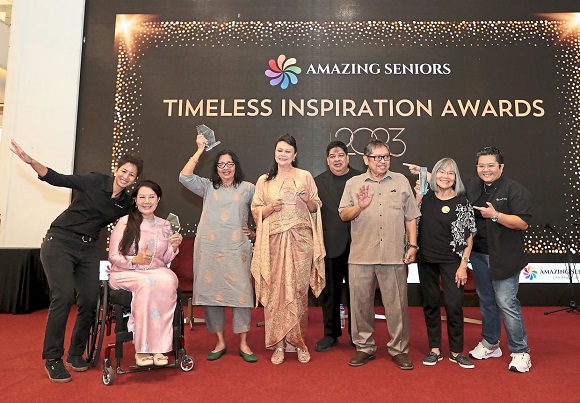
Amazing Seniors' Jasmin (far left) and Low (far right) with Timeless Inspiration Awards and Community Leadership Awardees (from left) Ras Adiba, Ivy, Khadijah, Lat (in brown) and Fu. (The Star)

One of the open secrets to ageing well and being able to remain fit and do most of the things we enjoyed doing in our younger days is to start laying the foundation early.

If you have missed out on an early start, it’s never too late to begin adopting a healthy lifestyle. A daily exercise regime helps to strengthen our immune system and protect our body against frailty. If you don’t have the discipline to exercise on your own, join a line dance class or an outdoors group that goes hiking or brisk walking regularly.

Community Leadership Award
recipient Lily Fu founder of
SeniorsAloud community. (The Star)
The social connection in group activities is an added benefit. Having supportive friends helps to keep our spirits up and drives away any hint of depression especially for seniors living alone.

The current generation of older people – the baby boomers, born during the post-WW2 boom years 1946 to 1964, is the first wave of retirees who have had the benefit of education and gainful employment.

They are now reaping the rewards of years of hard work, enjoying financial security and living life to the fullest. These septuagenarians and octogenarians are giving “old age” a brand-new meaning and image.

Thanks to advances in medicine, science and technology, the “new old” are fitter, healthier and looking much younger than their parents’ generation.

And their numbers are growing, worldwide. 

We need not look further for evidence of this new breed of seniors than in the recently concluded three-day Senior Festival organised by Amazing Seniors.

The Talent Quest event was an excellent showcase of the new seniors. Looking at them singing and dancing with gusto on stage, the young ones in the audience couldn’t help but be amazed at the energy and the spirit of fun these seniors displayed. Who could believe the models in the fashion show were seniors with the oldest at 85?

The seniors in the Malay dances and those on the ukeleles showed that older people can learn from scratch anything if they have the interest and passion to do so.

SeniorsAloud members taking part in a fun fashion show for the first-time. Most are in their 60s, with the oldest at 85.

The new old are breaking all the rules on how we should age. Who says Grandmas are not supposed to look glamorous? Where does it say Grandpas shouldn’t have fun? Which handbook or religious book are these do’s and don’ts coming from?

Where does it say that older people should behave a certain way? The retirement years are for enjoying life. We deserve a well-earned rest after years of work.

What a terrible waste of precious time if we spend it counting the days and preparing religiously to hear that last boarding call for our final departure. If we are always afraid of death and ageing, and spend our time getting ready to depart, our lives will truly be grey.

Looking ahead with anticipation

We need to face ageing with positivity. So go out there. Try new experiences as long as they are not a risk to life or limb. The new generation of seniors are ready to venture forth to where their predecessors had feared to go.

They are saying no to social stigmas that dictate how older people should behave, or face public ridicule, scorn, even ostracism.

They are shattering the long-held perception of older people as frail, senile and economically unproductive, and a drain on the country’s resources.

Those who do not have the means, such as time, money and education to age well envy those who are ‘privileged’.

But why envy? Envy gets us nowhere. Take action. Anyone and everyone can age well.

Seniors love the outdoors to keep fit and active.

Getting our body moving is free. So are fresh air and sunlight. Thoughts are free too. Think positive. Think hope. You will be surprised what a huge dose of positivity and good habits can do for our health and wellbeing.

It’s a cliche but it needs repeating – change begins with us.

Our health is our responsibility. We know what to do, but we don’t do it. A lack of motivation makes us complacent until a serious health issue triggers an immediate response – an emergency trip to the doctor or the hospital.

Change takes time, but older people don’t have the luxury of time. So just do it. Live healthy, live well, live long.


I used to be amused at cartoons and jokes that poke fun at old people, depicting them as senile and
forgetful, like taking ages to cross a road and holding up traffic, or using Tipp-Ex to erase typos on the computer screen.

These images only reinforce the negative perception of older people as unfit for re-employment, and a drain on the nation’s resources. Such depictions of older people are in poor taste.

It explains why ageism is still being practised especially in the job market, and older people continue to be overlooked or discriminated against.

As the country moves into an era that will see a huge demographic shift, it is pertinent that we change how society looks at older people. It’s time we see them through new lens that focus on their strengths, their experience and their talents.

Hopefully, the new old will herald a more positive perception of our senior citizens as vibrant and still capable of contributing much to the economy and to nation-building.

Lily Fu is a gerontologist who advocates for seniors. She is founder of SeniorsAloud, an online platform for seniors to get connected and enjoy social activities for ageing well.

(The above article was first published in The Star print edition on Wed 25 Oct 2023 under the Grey Matters column. Access the link here.)

Thursday, October 5, 2023

FROM HOME SWEET HOME TO NURSING HOME

Make sure to find out if the home has certified nurses and trained support staff. Photo: 123rf.com

Whether we like it or not, there will come a time when we have to seriously consider where we see ourselves living 20 years after retirement. Given a choice, most of us senior citizens would prefer to age in place, that is, age at home in familiar surroundings.

Much as we may desire this, it may not be in our best interest. There will come a day when we find ourselves living alone. We may be fit and enjoying good health in our retirement years.

But all it takes is a fall to render us helpless, unable to get up and call for assistance. Climbing the ladder to change a bulb or reach for a jar on the top shelf may result in a mishap that sees us ending up with a broken hip and in a wheelchair.

As for adult children, they worry about their elderly parent being alone at home. They dread getting a call informing them something dreadful has happened to dear mom or dad. What if Dad suddenly has a stroke? There’s no one at home to call for an ambulance. What if Mum who has Alzheimer’s wanders out and can’t remember the way home? Worse, what if Dad experiences a cardiac arrest, and his body remains undiscovered till a week later?

Such cases have been reported in the media. We need to seriously consider the likelihood of moving to an aged care facility at some point in our later years. Living with our adult children may not be an option available to us. They may have settled overseas or are working in another city. Even when there is room in their home, the elderly parent may not want to move in and lose their freedom and independence.

There could be many reasons why the number of Home Alone elderly has risen in recent years. Only a small percent is due to a lack of filial piety. It’s best to be prepared for that eventuality and start checking out retirement homes and assisted living facilities, rather than wait for an emergency to happen and we end up leaving that choice out of our hands.

At least come up with a shortlist and share it with our children.

A nursing home with a garden scores a plus point. Residents can enjoy the outdoor sunlight and fresh air, and engage in some exercise, or in gardening.

Let’s start with private nursing homes which have been mushrooming in recent years in response to Malaysia’s growing ageing population. Operating an aged care facility, whether a nursing home or a daycare centre, has become a thriving business. Private nursing homes are a common sight in residential neighbourhoods.

Most are housed in converted bungalows or former service apartments rather than as purpose-built facilities. Nearly all have attractive websites promising quiet surroundings, daily activities and tender loving care.

Don’t be taken in by the marketing hype. The fees depend largely on the level of care required, and the services and facilities offered. Be prepared to cough up between RM3,000 to RM8,000 a month.

What do the fees cover besides meals? Laundry? Diapers? Medication? Personal toiletries? Personal grooming-haircuts, manicure, pedicure? Are there regular triage checks? The high-end ones offer a resort lifestyle, complete with swimming pool, gym, karaoke, ensuite rooms. In short, it’s akin to living in a five-star hotel, so be prepared to pay five-star fees. For the majority, even at RM3,000, most adult children can ill afford it, given their many financial commitments. With longer life expectancy, the sandwich generation of adult children has now expanded to include retirees who are carers for their elderly parent aged 90+.

With no income, limited savings, and their own declining health, these retirees struggle to look after their aged parents.

Here are some questions as a guide

1. What is your first impression of the facility? Clean? Well-ventilated and well-lit? Elder-friendly furniture and fixtures? Quiet surroundings? Safe and comfortable environment? Any greenery? If it’s a double-storey building, look for a fire escape outside. If the home looks uninviting from the outside, there really is no point ringing the doorbell. It would be a total waste of your time.

2. Is the home licensed? This serves as a good guide as certain conditions such as fire safety need to be fulfilled before a license can be issued. Ask whether there is a proper admission procedure. Is there a management team to oversee running of the home? Homes that are operated by one or two individuals with little relevant experience or qualifications are likely to be unlicensed.

3. Are the nurses certified and the support staff trained? Remember, you will be leaving your loved one in their care 24/7. Do they treat the residents with respect and patience? Is there a resident doctor or physiotherapist? Do the staff look overworked or unfriendly? Are they mostly foreigners or locals? Are they able to communicate with the elderly to understand their needs? What are the provisions for emergencies? Do the staff keep you informed about your loved one when you are away? What is the staff to residents ratio?

4. Are there meals planned with the dietary needs of the elderly in mind? Is the menu changed daily? Is there a weekly programme of activities such as morning exercises, art and music sessions? Or are the residents left to themselves to watch TV most of the time? Does the home arrange for outings or for volunteer groups to visit regularly and interact with the residents? Do the elderly residents look neglected and bored?

Ask around for recommendations from friends who have a family member in a nursing home. Do some research online to back up a recommendation. Then contact the home to arrange for a visit.

If they say you are welcome to drop by anytime, it is a good sign that they are prepared to be ‘inspected’ at your convenience, and not theirs. Remember to ask the right questions during the visit, and make a mental note of everything you see, both good and not so good.

I hope this article gives you an idea of what to look for in a good retirement home or nursing home for yourself or for an elderly. You will be surprised how many homes you will strike out from your list before you finally find one that could be the answer to your prayers.

This article by Lily Fu was first published in The Star (Mon, 02 Oct 2023) in the Grey Matters column. The online edition can be accessed at this link: https://www.thestar.com.my/lifestyle/family/2023/10/02/starsilver-from-home-sweet-home-to-nursing-home

(Lily Fu is a gerontologist who advocates for seniors. She is founder of SeniorsAloud, an online platform for seniors to get connected and enjoy social activities for ageing well.)