Tuesday, May 23, 2023

IS THERE A RIGHT AGE TO RETIRE?

One idea to consider is to let workers decide for themselves and be given the option to work as long as they are able to, or need to, says gerontologist Lily Fu. Photo: 123rf.com

Thursday, 11 May 2023

By LILY FU

Former PM Tun Mahathir, once jokingly said the new retirement age in Malaysia will be 95 when he hands over his premiership to his successor. That was in 2018. He may have said it in jest but at the rate our demography chart is changing, Malaysia will reach ageing nation status by 2030, when we will see more people working well into their 70s. This is inevitable.

When the Employees Provident Fund (EPF) was set up in 1951, life expectancy then, believe it or not, was 55! With the retirement age set at 55, lump sum EPF withdrawals would be more than sufficient to sustain contributors through the short retirement period. We now know those figures were way off the mark. Advances in science, medicine and technology have drastically extended life span. Life expectancy in Malaysia currently stands at 76, and is set to rise further in the years ahead. 60 is the new 40, and living to a ripe old age of 80 and beyond is fast becoming the norm.

But what good is a longer life span if we do not have sufficient savings to enjoy those extra years? According to EPF figures, 51.5% of its 6.67 million members under the age of 55 have less than Rm10,000 savings. EPF’s 2019 Expenditure Guide for Malaysian individuals and families in the Klang estimates that an elderly couple living in the Klang Valley would need at least RM3090 a month for living expenses, or at least RM240,000 in savings by the time they retire at 55. With prices escalating and inflation showing no sign of abating, for those living in the urban areas, this figure will be grossly inadequate in the years to come.

With longer life span, retirees in their 60s-70s have elderly parents in their 80s-90s to look after. Long term age care alone for their parents will eat up whatever savings they may have. What about their own medical and healthcare expenses? The family structure has changed so drastically that parents can no longer expect their adult children to support them in their old age. Family size has shrunk, and with the grown children moving out to work or settle elsewhere, older couples are often left to fend for themselves.

That is why more and more retirees are returning to work life almost immediately after retirement. And older workers want to continue working past 60. Except for those with ample savings, most older workers especially those from the lower socio-economic group can ill-afford to stop working. 

But getting a job is easier said than done. Older workers face age discrimination in the workplace. Unless they have skills that are highly sought after, and unless the government offers a helping hand to retrain and upskill older workers, many have difficulty re-entering the job market once they have left it. It certainly doesn’t help when the public has a negative perception of older persons as frail, senile and a burden to support.

We are moving rapidly into an ageing society. Businesses that deal with retail, travel and hospitality, for example, would do well to employ more silver-haired staff to cater to customers in the older age group. Indeed, older people make good workers. Here’s why.

They are mature and conscientious. They are committed to their job, and do not job-hop. They have excellent people skills, and are experienced in handling crisis and emergencies. Older customers definitely feel more comfortable with older sales personnel who understand their needs and tastes much better. They are also more patient and confident in handling customers’ requests or complaints.

On the other hand, unless they have much-needed skills or expertise, older workers seeking to re-enter the workforce should not be too picky about job offers and be prepared to accept lower remunerations and fewer benefits.

In acknowledging the plight of retirees and those nearing retirement age, the government has sought to increase job opportunities by offering tax incentives for employers hiring older Malaysians. More companies are offering pre-retirement courses to help their soon-to-retire employees prepare for the years ahead. Whether this will make a significant difference remains to be seen.

One thing is for certain - we can expect the retirement age to continue going up in tandem with the rise in life expectancy. In developed countries such as Singapore and Japan, life expectancy is 82.8 and 84.8 respectively. The retirement age is moving towards 65. Former PM of Singapore, Lee Kuan Yew, famously said that 'retirement means death', and was in favour of doing away with the retirement age.

Let workers decide for themselves. They should be given the option to work as long as they are able to, or need to. 

As it is, we are already complaining about escalating prices and soaring expenses. With inflation eating into our nest egg, we just have to keep on bringing home the bacon, especially if we have college-going children and elderly parents to support. 

When older workers continue working, everyone benefits. The older workers themselves can remain self-supporting. For young people, they can be thankful that their working parents can fend for themselves and not be a financial burden to them. The government can save billions that would otherwise have to be spent on welfare aid for older citizens. Companies will be able to address labour shortage by hiring from a big pool of mature workers.

So, whichever way we look at the situation, the retirement age will have to be raised. The likelihood of doing away with a retirement age altogether will gain traction in the years ahead. Let's just hope it won't reach a situation where we have to work until we drop dead!

(The above article was first published in The Star under the monthly column 'GREY MATTERS'.)

Saturday, April 29, 2023

A CRYING NEED FOR A DEPARTMENT OF AGEING TO TAKE CARE OF OUR ELDERLY

Unless we have prepared well, the years after retirement can be far from golden. — 123rf.com

by LILY FU
Wednesday 12 April 2023

Working folks envy their colleagues who have retired. No more nine to five, no more taking orders from the boss, no more stress from meeting deadlines or worrying about ROI.

They have all the time now to do what they like, go where they want and be able to finally pursue their dreams, whether it’s to travel, take up a new hobby or get a degree.

This is an idealised picture of retirement. Unless we have prepared well, the retirement years can be far from golden. Just take a walk in the inner-city streets, the back alleys, or visit low-cost flats (PPR). You will see the other side of retirement. Not a pretty picture.

Every so often we read about an elderly abandoned at the bus-stop or at a hospital.

According to the Social Welfare Department (JKM), about 2000 elderly have checked into welfare homes over the past five years. The actual figure is probably much higher. An estimated 71% of EPF contributors do not have enough savings to live above the poverty line.

To be fair, there have been improvements over the years. Senior citizens enjoy discounts on public transport. Medical care is practically free at government clinics, and easily affordable at public hospitals. Elder-friendly facilities are now fixtures in public buildings, and there are special lanes in government departments to serve the elderly.

There are plans to have an activity centre for seniors (Pusat Activiti Warga Emas or PAWE) in every parliamentary constituency. The grant for each PAWE to run the centre has been raised from RM33,330 to RM50,000 annually. All very good, but these improvements have been long overdue, and are a very small step towards preparing for the future.

There are plans to have an activity centre for seniors (PAWE) in every parliamentary constituency such as this one in Taman Medan, Petaling Jaya. The grant for each PAWE to run the centre has been raised from RM33,330 to RM50,000 annually. These improvements have been long overdue, and are a very small step towards preparing for the future. - Filepic

Based on findings of the on-going Malaysia Ageing and Retirement Survey (MARS) conducted by Universiti Malaya’s Social Wellbeing Research Centre, and involving 5,613 respondents, Malaysia will be classified as a super-aged nation by 2056 when 20% of the population is aged 65 and above.

Academicians and researchers on ageing have conducted countless surveys over the years. It is such a waste of time, money and effort when nothing much happens after they have presented their findings to the government.

The proposal to introduce legislations against elder abuse and abandonment has been brought up now and then over the past two decades. Each time the issue raises a storm of controversy, then the buzz fizzles out till the next time it is mentioned again in Parliament.

As an example, in Sept 2019, then Deputy PM and Women, Family and Community Development Minister Datuk Seri Dr Wan Azizah Wan Ismail announced the Senior Citizens Bill would be tabled in Parliament in early 2021.

With the subsequent change in government, the bill was left in limbo. Fast forward to March 2023. Current Deputy Minister Aiman Athirah Sabu, in responding to a question, said the bill would be tabled in Parliament for the first reading in 2024! When that time comes, will there be yet another delay? Will the same scenario repeat itself?

Speaking in the Dewan Rakyat recently, Women’s Minister Datuk Seri Nancy Shukri, commended the National Senior Citizens Advisory and Consultative Council (MPPWEN) on their role they played. The council meets only twice a year. The urgency is not there.

There is a crying need for an inter-ministerial committee on Ageing. Any action plan on ageing should involve more than just the Women, Family and Community Development Ministry.

NGOs, CSOs and representatives from the B40 group should also be at the table. These are the grassroot leaders who are familiar with the problems faced and are directly impacted by any decisions made. They speak from lived experience, and their voices should be heard.

Bear in mind proposals and plans are just that, on paper and in discussions in meeting rooms where the elderly who are the target group do not have a seat at the table.

Even when Acts and Bills are passed, implementation is painfully slow due to bureaucratic red tape. The Social Welfare Department (JKM) has too much on its plate: from the welfare of women, children, senior citizens, OKU to the community at large.

Each demographic group has its own set of issues to deal with. When resources are limited, priority is often given to women, children and youths.

After all, for the elderly their days are numbered. They do not contribute much to the economy and in fact are seen as a drain on limited resources for welfare.

These retirees and pensioners, mostly in their 70s and 80s, have contributed much to nation-building in their younger days. Now in their twilight years, they are overlooked, if not forgotten in the broader scheme of things.

The haves can take care of themselves. Our concern is the have-nots – theB40 elderly and those living without family support. Aside from the crumbs given to senior citizens at every Budget allocation, they are often shut out in the job market, and denied opportunities to better themselves.

What they need is sustained financial support, not one-off handouts as and when, and also access to long-term health care. How long do the elderly have to wait for better days ahead in the time they have left? It is a time bomb ticking away when we consider the ramifications an ageing population presents.

(The above article was originally published in Star Silver pullout of The Star under the column 'Grey Matters'.)

Sunday, March 19, 2023

ARE WE MODELS OF FILIAL PIETY FOR OUR CHILDREN?


Are we baby boomers the last line of defence left to uphold and preserve filial piety? If our adult children and grandchildren seem lacking in respect for their elders, are we as much to blame as the changing times and hence, changing values? Have we pampered and mollycoddled them too much? Have we allowed them to get away with indiscipline and disrespect to their parents and grandparents?

Getting to be a common sight in the city - the elderly having to fend for themselves.

What about us? We have elderly parents in their 80s to look after. Are we exemplary models for our adult children to emulate? Can we look at ourselves in the mirror and honestly say that we have looked after our elderly parents well, and given them our love and respect?

When was the last time we held our elderly parents' hands or gave them a hug?

When was the last time we hugged our parents or held their hands? They don't need gifts of money, hampers of food or bouquets of flowers. All they want is the reassurance that they have not been forsaken and forgotten by their family members.


When our parents are gone, can we ever forgive ourselves for neglecting them in their final years? The time for us to start is right now, before the sands of time run out for our elderly parents, and it's too late for regrets.

How we treat our elderly parents is how our children will treat us one day in our old age. They will learn from us.

Tuesday, February 28, 2023

IT'S CRUMBS AGAIN FOR SENIORS, LAMENTS ADVOCATE

KUALA LUMPUR: Gerontologist and advocate for seniors, Lily Fu (pic), wishes there are more funds for the elderly.

"Well, a bit of good news for some sectors but, generally, crumbs again for seniors. Not much to cheer about.

“If only we had a minister or an agency on aging to speak out for older people.

“All of us will age, and we also have elderly parents and grandparents. Most of the MPs are not spring chickens either.

“Why are the needs of the elderly often ignored or overlooked?” she lamented after the revised Budget 2023 was tabled at Parliament on Friday.

Fu is disappointed that there was no mention of age-friendly facilities and infrastructure or tax incentives for companies to employ older persons.

“There was no mention of special digital literacy programmes to help seniors grapple with technology.

“There was no tax allocation for families looking after the elderly who need long-term care or those with comorbidities.

“I feel that most of the allocations are catered for the B40 group,” said the 75-year-old, who is also the founder of Seniors Aloud, an online network of senior citizens.

Malaysia entered an ageing society in 2020.

With the population of its senior citizens (age 65 and above) standing at 7.3% now, the country is expected to enter an aged society about 21 years from now and eventually turn into a super-aged society in 2056.

The process is faster than previously projected due to a declining fertility rate and low birth rate.

According to the Statistics Department, a total of 439,744 babies were born in 2021, a 6.7% (31,760 births) drop from the previous year.

The Total Fertility Rate has also shown a declining trend from 4.9 children per woman of childbearing age (15 to 49 years) in 1970 to 1.7 in 2021.

Despite the Budget 2023 not targeting many goodies for senior citizens, retired teacher Josephine Odela Soosay Raj, 82, said she is still glad that overall, the budget benefits most Malaysians.

“From what I see, the budget will enable our country to move into a new phase that will see more foreign investors coming in.

“I’m also pleased that our Prime Minister is looking at the needs of the younger generation. He spoke about the problem of pornography and upgrading schools in rural areas.

“So for me, I feel that our country will have a new image,” said the former teacher of SK St Theresa 1 here.

The grandmother of five is happy about the government’s focus on the welfare of padi farmers and rubber tappers.

“A lot of money will be spent to upgrade clinics and hospitals and repair roads in flood-prone areas.

“I don’t mind that the senior citizens’ interests are left aside for now.

“Let our leader see to the needs of others. Once that’s in place, he should see to our needs,” she added.

(The above article was first published in The Star on Sunday 26 Feb 2023. The comments were made in response to the PM's Budget Speech delivered in Parliament on Fri 24 Feb.)

Sunday, January 29, 2023

LAUGHTER & NOSTALGIA AT THE BOOK REVIEW OF 'OUR STORIES, OUR LEGACY'

 
The happy faces reflect the success of the first book review held recently to connect the readers of  "Our Stories, Our Legacy" with the writers. More about the event in the writeup below, courtesy of Liow Moi Lee, editor of the book. 


Copies of the book are available for sale at these locations below: Mont Kiara, Bangsar and Ampang. Please contact Lily for more info. Thank you. 


Wednesday, November 30, 2022

SENIOR CITIZENS' VOICE MATTER


The anxiety of waiting for the results of GE15 is over, as is the jubilance. Very soon, the new cabinet will be announced. It will then be time to get down to brass tacks for our new unity government. We understand PM Anwar has plenty on his plate at the moment, so no demands just a wish list for him and the relevant ministries to work on as soon as he has seen to the top priorities.

But first, let me share my comments in an interview published in The Star dated 2 October. (I have taken the liberty to add my own images.)

"Every election, you can see many senior citizens lining up for hours at voting stations despite their weakness and frailty, just to carry out their democratic duty and cast their vote.

In return, our prospective representatives should pay this sage cohort the attention they deserve, especially now with many facing the brunt of inflation and the rising cost of living.


As gerontologist Lily Fu puts it, seniors like her would vote for candidates who will support and push for reforms that benefit seniors and the community they live in.

“We would also choose a candidate or party that acts for all older people without discriminating against race or religion, someone who understands the challenges of ageing and is proactive about seeking solutions.

“It is also important that the candidate we vote in will listen to the voices and feedback of seniors before implementing anything to ensure success. Because, otherwise, it’s money and resources down the drain,” says the 74-year-old who is also the founder of Seniors Aloud, an online network of senior citizens.

At present we do not have an inter-ministerial committee on ageing, but we do have a Malaysian Coalition On Ageing (MCOA) launched in Feb 2022.

Fu also urges for an agency for an ageing population to be set up to push for the needs and rights of older people.

She points out that among the most pressing issues for seniors is the provision of long-term care centers, particularly for seniors with no family or financial support.

“Currently, there are only two government-run ones in whole country!” she points out.

Me interviewing two senior citizens who are looking for jobs. They spoke about the difficulty in getting employed because of their age. They are in their 60s but still fit and able to work.

The government must also stamp out ageism in employment, she says.

“Open job opportunities to able seniors who want to work to support themselves [and their families]. The new 60-year-olds are not frail, senile or ready to drop dead! There is a huge pool of retirees with a wealth of expertise and experience to draw on, given the shrinking young labour force.

“In this respect, the government should also open digital and entrepreneurial training and upskilling opportunities to older people. Publicize HRDF [Human Resources Development Fund] workshops, etc, so that these seniors can apply for them,” Fu says.

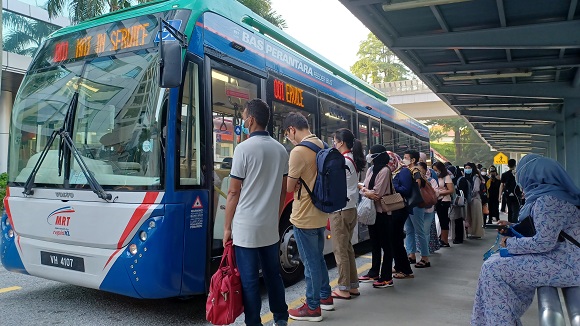
A common sight at the Semantan MRT station. Long queues of commuters waiting in the sweltering noon heat. Oftentimes there are five to six buses with 'Out of service' displayed and the drivers sitting inside in air-con comfort busy scrolling on their mobile phones.

Another big area that needs attention is improving the country’s public transport system for the aged, especially for the last mile, she adds.

“The buses, especially feeder buses, are the bane of commuters. A total revamp is much needed. Also, have more age-friendly facilities in public places. When the government takes care of the public safety and needs of seniors, everyone benefits.

There should also be sustainable programs for the welfare and wellbeing of older people. It is pointless to have occasional, one-off campaigns. They don’t work.”

Senior citizens queuing up for food packages during the Covid pandemic. Most are jobless.

The recent Budget 2023 delivered by the former Minister of Finance on 7 Oct was a huge disappointment for senior citizens and the elderly. Once again, they were given crumbs. So, that begs the question, what can our government offer us older Malaysians to make us happy and looking forward to our retirement years? We have given 30-40 of our prime years in the service of the country. Surely that must merit some recognition and appreciation?

Above all, we want to be accorded respect and dignity, not be ignored or seen as unproductive and a burden to society

We certainly don't want empty pre-election promises of what the government can do or will do for us. We don't want vague general references to what it plans to do for seniors. We want details, specifics and deadlines. And if the government doesn't deliver, we have the right to protest, to hold it accountable if it reneges on its word, and not vote for any under-performing ministers should he or she stand for re-election. 

So, what do we want?


Here's a short checklist to begin with for the relevant ministries to take note of. In no particular order.
  • more elder-friendly facilities in public places e.g. government buildings, parks and hospitals. More benches to rest weary feet, decent public toilets, priority queues for the elderly, etc.
  • a public transport system (and transport hubs) that takes into account the physical limitations of the elderly and OKUs. There has been vast improvement in the MRT-LRT lines, but bus transport and the peripherals suck, and need urgent upgrading.
  • a senior privilege card with genuine discounts that covers items seniors regularly spend on. By 'genuine' we mean 'without a long list of terms and conditions'. The government should give seniors a discount card similar to the one for university students.
  • well-maintained and fully-equipped senior community centers in every housing area or constituency, not rundown under-utilized community halls that are usually locked up. 
  • more opportunities for re-training and re-employment of seniors so they can return to the work force to supplement their savings
  • more affordable nursing care for those who require long term care, and well-managed welfare homes for the elderly 
  • more lifelong learning programs similar to that offered at University of the Third Age at UPM Serdang to be extended to other states
  • no age discrimination but respect for all seniors, please
Morning exercises at a well-run assisted living facility set up by an NGO.

SeniorsAloud has been making these proposals as far back as 2009. We will continue to voice our concerns till we are heard.

To be fair and give credit where credit is due, we do appreciate the government's efforts in making public healthcare accessible and affordable to seniors. We welcome the 50% discount for seniors travelling on trains and buses, and the priority lanes for warga emas at government departments. We also acknowledge the financial assistance given to Selangor residents for funeral expenses under the Mesra Usia Emas Scheme and other schemes. 

But these provisions are either limited, too slow in implementation, or if already available are not efficiently maintained or managed. Moreover, most of these are concentrated in the Klang Valley. What about in other states? What about in Sabah and Sarawak? What is the govt doing for the wellbeing of the seniors and the elderly in these areas? Is it sufficient?

Many of our ministers are seniors themselves. Like us, they have elderly parents. The big difference is we are from the grassroots, they are from the ivory towers. One day they too will be elderly. Isn't it time they gave more attention to what senior citizens and the elderly want?

Friday, October 28, 2022

STORIES WITH PLENTY OF HEART… AND HISTORY

STORIES WITH PLENTY OF HEART… AND HISTORY

A review by Liow Moi Lee

Where to start with a collection of stories that is part memoir, part social commentary and part reflection on our history? Perhaps we can start with our community of feisty and energetic senior citizens with a love for writing and a penchant for telling stories. Then, one woman’s vision to create a platform for these stories, capture their essence as a legacy and share them as our collective heritage. This is possibly the first book of its kind in Malaysia. 

'Our Stories, Our Legacy' brings together 38 stories of growing up in Malaya/Malaysia of the 1950s, 1960s and 1970s, three decades of big social and economic changes for our then young nation. With the passage of time, this ‘world’ is fading fast but for the recollections of our senior citizens, the Merdeka generation. Each story in this book, deeply personal and lovingly written with clarity, humour and plenty of heart, is a testament to the power of memories and lessons from rich life experiences. 

From 'Life During the Japanese Occupation'. (Source: Wikimedia Commons)

In Pre-Merdeka Years, six stories about the Japanese Occupation, World War II and British rule offer vivid recollections of the horror of war on ordinary families, the impact of foreign rule on life in the kampung, on food shortages, on hiding and escape, on conscription, and later, on organising to fight for independence. A rickety old bridge stirs up fond memories of a child’s daily anxiety and amusement. Till today the remnants of the British colonial period continue to colour the lives of many, in both physical and emotional ways as described in 'The Hill of Education has no Summit' and 'The Polished Rock'. 

School dance competition from 'Secondary School Years in a Mission School'

The 10 or so years we spend in schools are hugely influential in shaping our young minds and preparing us for our future as adults, whether in the 1960s or today. The eight stories under School Days are full of fun, adolescent energy and innocent charm. From glowing admiration of teachers, forming of lifelong friendship or witty remembrances, parents and teachers’ arsenal of discipline tools and keeping scores, simple games for amusement to the first brush with sexual curiosity and raging hormones, we know it all so well! 

From the story 'A Weekend Sleepover with Grandma in the 1960s'.

Family Ties are, as expected, where our writers have the most profound recollections. The 11 stories in this category offer glimpses of family life from 1950s to 1970s. The colonial-era shophouse is emblematic of the practicality of merging family life with family livelihood. Appreciative tributes to fathers and mothers who made do with so little, and yet provided a loving memorable environment for their children. The sweet role played by grandparents, the lure of the cinema with mom including shopping and sweets, simple observations of life as a child of a government district official or on a daily trip to buy groceries all recall a world of resilient, resourceful families in those early days of post-1957 nation-building. 

Nowhere is change more rapid and obvious than in the work place (Memories of Work). From the perspective of a young typist/office worker, the ever-increasing array of new and more complex typing and documenting equipment is evidence of the fast pace of change in society, even then. We needed to adapt, and adapt quickly. The nursing profession was, it seems in the 1960s-70s, a popular choice of vocation of female school leavers, especially if it involved a foreign country, usually the UK. But cultural discovery could also be experienced at home as a big-city girl got an eye-opening adventure from a teacher’s posting to a far-off conservative East Coast state.   

From 'Deepavali Nostalgia'

The nine stories in Fun and Festivities convey the spirit of family togetherness during festivals and holidays, our great obsession with food, and priceless recipes and skills passed on by our mothers . There are cheeky accounts of childhood adventures at the cinema and kids being kids playing with each other. Alas, that cinema in Malacca is now in a sorry state of disrepair while children in 2022 play with tech toys indoors, not hopscotching outside. A trip to a popular park provides gentle flashbacks to a less crowded and more innocent time, while 'Getting Old' reminds our Warga Mas that there is life in us still, so stay healthy and enjoy it!  


The images above did not make it into the book, but we remember them well growing up
in the 60s and 70s.

'Our Stories, Our Legacy' is thoroughly Malaysian in character and flavour. In every story, on every page, we discern common threads of a shared culture and values system through our upbringing and schooling, family life, sense of humour, love of food, friendships, and even entertainment, amongst many things. Despite our different ethnicities, religions and customs, we are Malaysian at our core. Whether set in Klang, Kuala Lumpur, Teluk Anson or Temerloh and Kota Bharu, the writers’ stories feel like a warm hug or a nice teh tarik on a rainy day.  

A collage of vintage photos that we couldn't include due to space constraints. They tell of the old days when the pace was slow and leisurely, and there was always time to relax and enjoy life .

For younger readers, perhaps from the later Baby Boomers onwards, this collection of stories is a legacy to you from the Merdeka generation. If you are in your 20s, 30s or even 40s, you may not recognise the world of the 1950s, ‘60s and ‘70s, but our senior citizens, growing up then, had fun, with similar hopes and aspirations for their future.  While we all now wrestle with the latest flip-phones, 5G, AI or hybrid work place in a post-Covid world, do take time out to give 'Our Stories, Our Legacy' a read. It may make you relax and smile, and you will certainly look at our senior citizens, including your (older) parents and grandparents, with new eyes.       

-----------------------------------

What others say about the book

‘This book is a treasure that documents the different webs of life and trajectories of Malay, Chinese and Indian communities in Malaysia, culminating in harmonious cohesion, away for life that is truly Malaysian.’ 

‘This is a book I cannot stop reading.’

‘This is indeed a huge contribution, the first of its kind, by a group of seniors to leave behind priceless memories for themselves, their families, the community and future generations to come.’

"I started reading the book which Angeline kindly delivered today. I could not put it down!"

"My mother also read a story from it (about BB Park) and she loved it. So the book is for anyone upwards of our age group and would make great gifts."

"I recognised so many things mentioned, from collecting autographs to eating shaved ice balls to the description of playing five stones and hopscotch. The best thing is that I can share the book with my children and they will know what growing up was like for me."

"Can't wait to read mine. Also thought they would make great gifts. It's great that all these stories are written down before they're lost. We have a very different new generation today that doesn't even know what fountain pens, rotary phones etc are."

Copies of the book are available for sale at locations in Mont Kiara, Bangsar and Ampang. Please contact Lily for more info. Thank you.