The happy faces reflect the success of the first book review held recently to connect the readers of "Our Stories, Our Legacy" with the writers. More about the event in the writeup below, courtesy of Liow Moi Lee, editor of the book.
Copies of the book are available for sale at these locations below: Mont Kiara, Bangsar and Ampang. Please contact Lily for more info. Thank you.
The anxiety of waiting for the results of GE15 is over, as is the jubilance. Very soon, the new cabinet will be announced. It will then be time to get down to brass tacks for our new unity government. We understand PM Anwar has plenty on his plate at the moment, so no demands just a wish list for him and the relevant ministries to work on as soon as he has seen to the top priorities.
But first, let me share my comments in an interview published in The Star dated 2 October. (I have taken the liberty to add my own images.)
"Every election, you can see many senior citizens lining up for hours at voting stations despite their weakness and frailty, just to carry out their democratic duty and cast their vote.
In return, our prospective representatives should pay this sage cohort the attention they deserve, especially now with many facing the brunt of inflation and the rising cost of living.
As gerontologist Lily Fu puts it, seniors like her would vote for candidates who will support and push for reforms that benefit seniors and the community they live in.
“We would also choose a candidate or party that acts for all older people without discriminating against race or religion, someone who understands the challenges of ageing and is proactive about seeking solutions.
“It is also important that the candidate we vote in will listen to the voices and feedback of seniors before implementing anything to ensure success. Because, otherwise, it’s money and resources down the drain,” says the 74-year-old who is also the founder of Seniors Aloud, an online network of senior citizens.
Fu also urges for an agency for an ageing population to be set up to push for the needs and rights of older people.
She points out that among the most pressing issues for seniors is the provision of long-term care centers, particularly for seniors with no family or financial support.
“Currently, there are only two government-run ones in whole country!” she points out.
Me interviewing two senior citizens who are looking for jobs. They spoke about the difficulty in getting employed because of their age. They are in their 60s but still fit and able to work.
The government must also stamp out ageism in employment, she says.
“Open job opportunities to able seniors who want to work to support themselves [and their families]. The new 60-year-olds are not frail, senile or ready to drop dead! There is a huge pool of retirees with a wealth of expertise and experience to draw on, given the shrinking young labour force.
“In this respect, the government should also open digital and entrepreneurial training and upskilling opportunities to older people. Publicize HRDF [Human Resources Development Fund] workshops, etc, so that these seniors can apply for them,” Fu says.
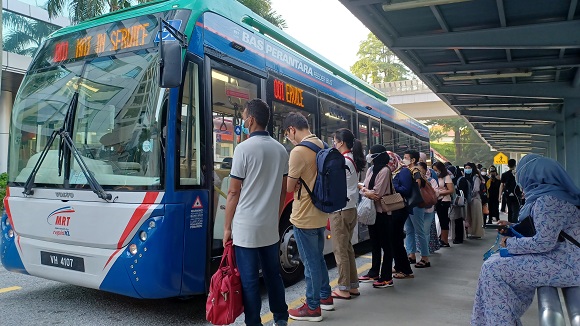
A common sight at the Semantan MRT station. Long queues of commuters waiting in the sweltering noon heat. Oftentimes there are five to six buses with 'Out of service' displayed and the drivers sitting inside in air-con comfort busy scrolling on their mobile phones.
Another big area that needs attention is improving the country’s public transport system for the aged, especially for the last mile, she adds.
“The buses, especially feeder buses, are the bane of commuters. A total revamp is much needed. Also, have more age-friendly facilities in public places. When the government takes care of the public safety and needs of seniors, everyone benefits.
There should also be sustainable programs for the welfare and wellbeing of older people. It is pointless to have occasional, one-off campaigns. They don’t work.”
Senior citizens queuing up for food packages during the Covid pandemic. Most are jobless.
The recent Budget 2023 delivered by the former Minister of Finance on 7 Oct was a huge disappointment for senior citizens and the elderly. Once again, they were given crumbs. So, that begs the question, what can our government offer us older Malaysians to make us happy and looking forward to our retirement years? We have given 30-40 of our prime years in the service of the country. Surely that must merit some recognition and appreciation?
Above all, we want to be accorded respect and dignity, not be ignored or seen as unproductive and a burden to society
We certainly don't want empty pre-election promises of what the government can do or will do for us. We don't want vague general references to what it plans to do for seniors. We want details, specifics and deadlines. And if the government doesn't deliver, we have the right to protest, to hold it accountable if it reneges on its word, and not vote for any under-performing ministers should he or she stand for re-election.
So, what do we want?
Here's a short checklist to begin with for the relevant ministries to take note of. In no particular order.
more elder-friendly facilities in public places e.g. government buildings, parks and hospitals. More benches to rest weary feet, decent public toilets, priority queues for the elderly, etc.
a public transport system (and transport hubs) that takes into account the physical limitations of the elderly and OKUs. There has been vast improvement in the MRT-LRT lines, but bus transport and the peripherals suck, and need urgent upgrading.
a senior privilege card with genuine discounts that covers items seniors regularly spend on. By 'genuine' we mean 'without a long list of terms and conditions'. The government should give seniors a discount card similar to the one for university students.
well-maintainedand fully-equipped senior community centers in every housing area or constituency, not rundown under-utilized community halls that are usually locked up.
more opportunities for re-training and re-employment of seniors so they can return to the work force to supplement their savings
more affordable nursing care for those who require long term care, and well-managed welfare homes for the elderly
more lifelong learning programs similar to that offered at University of the Third Age at UPM Serdang to be extended to other states
no age discrimination but respect for all seniors, please
Morning exercises at a well-run assisted living facility set up by an NGO.
SeniorsAloud has been making these proposals as far back as 2009. We will continue to voice our concerns till we are heard.
To be fair and give credit where credit is due, we do appreciate the government's efforts in making public healthcare accessible and affordable to seniors. We welcome the 50% discount for seniors travelling on trains and buses, and the priority lanes for warga emas at government departments. We also acknowledge the financial assistance given to Selangor residents for funeral expenses under the Mesra Usia Emas Scheme and other schemes.
But these provisions are either limited, too slow in implementation, or if already available are not efficiently maintained or managed. Moreover, most of these are concentrated in the Klang Valley. What about in other states? What about in Sabah and Sarawak? What is the govt doing for the wellbeing of the seniors and the elderly in these areas? Is it sufficient?
Many of our ministers are seniors themselves. Like us, they have elderly parents. The big difference is we are from the grassroots, they are from the ivory towers. One day they too will be elderly. Isn't it time they gave more attention to what senior citizens and the elderly want?
Where to start with a collection of stories that is part memoir, part social commentary and part reflection on our history? Perhaps we can start with our community of feisty and energetic senior citizens with a love for writing and a penchant for telling stories. Then, one woman’s vision to create a platform for these stories, capture their essence as a legacy and share them as our collective heritage. This is possibly the first book of its kind in Malaysia.
'Our Stories, Our Legacy' brings together 38 stories of growing up in Malaya/Malaysia of the 1950s, 1960s and 1970s, three decades of big social and economic changes for our then young nation. With the passage of time, this ‘world’ is fading fast but for the recollections of our senior citizens, the Merdeka generation. Each story in this book, deeply personal and lovingly written with clarity, humour and plenty of heart, is a testament to the power of memories and lessons from rich life experiences.
From 'Life During the Japanese Occupation'. (Source: Wikimedia Commons)
In Pre-Merdeka Years, six stories about the Japanese Occupation, World War II and British rule offer vivid recollections of the horror of war on ordinary families, the impact of foreign rule on life in the kampung, on food shortages, on hiding and escape, on conscription, and later, on organising to fight for independence. A rickety old bridge stirs up fond memories of a child’s daily anxiety and amusement. Till today the remnants of the British colonial period continue to colour the lives of many, in both physical and emotional ways as described in 'The Hill of Education has no Summit' and 'The Polished Rock'.
School dance competition from 'Secondary School Years in a Mission School'
The 10 or so years we spend in schools are hugely influential in shaping our young minds and preparing us for our future as adults, whether in the 1960s or today. The eight stories under School Days are full of fun, adolescent energy and innocent charm. From glowing admiration of teachers, forming of lifelong friendship or witty remembrances, parents and teachers’ arsenal of discipline tools and keeping scores, simple games for amusement to the first brush with sexual curiosity and raging hormones, we know it all so well!
From the story 'A Weekend Sleepover with Grandma in the 1960s'.
Family Ties are, as expected, where our writers have the most profound recollections. The 11 stories in this category offer glimpses of family life from 1950s to 1970s. The colonial-era shophouse is emblematic of the practicality of merging family life with family livelihood. Appreciative tributes to fathers and mothers who made do with so little, and yet provided a loving memorable environment for their children. The sweet role played by grandparents, the lure of the cinema with mom including shopping and sweets, simple observations of life as a child of a government district official or on a daily trip to buy groceries all recall a world of resilient, resourceful families in those early days of post-1957 nation-building.
Nowhere is change more rapid and obvious than in the work place (Memories of Work). From the perspective of a young typist/office worker, the ever-increasing array of new and more complex typing and documenting equipment is evidence of the fast pace of change in society, even then. We needed to adapt, and adapt quickly. The nursing profession was, it seems in the 1960s-70s, a popular choice of vocation of female school leavers, especially if it involved a foreign country, usually the UK. But cultural discovery could also be experienced at home as a big-city girl got an eye-opening adventure from a teacher’s posting to a far-off conservative East Coast state.
From 'Deepavali Nostalgia'
The nine stories in Fun and Festivities convey the spirit of family togetherness during festivals and holidays, our great obsession with food, and priceless recipes and skills passed on by our mothers . There are cheeky accounts of childhood adventures at the cinema and kids being kids playing with each other. Alas, that cinema in Malacca is now in a sorry state of disrepair while children in 2022 play with tech toys indoors, not hopscotching outside. A trip to a popular park provides gentle flashbacks to a less crowded and more innocent time, while 'Getting Old' reminds our Warga Mas that there is life in us still, so stay healthy and enjoy it!
The images above did not make it into the book, but we remember them well growing up in the 60s and 70s.
'Our Stories, Our Legacy' is thoroughly Malaysian in character and flavour. In every story, on every page, we discern common threads of a shared culture and values system through our upbringing and schooling, family life, sense of humour, love of food, friendships, and even entertainment, amongst many things. Despite our different ethnicities, religions and customs, we are Malaysian at our core. Whether set in Klang, Kuala Lumpur, Teluk Anson or Temerloh and Kota Bharu, the writers’ stories feel like a warm hug or a nice teh tarik on a rainy day.
A collage of vintage photos that we couldn't include due to space constraints. They tell of the old days when the pace was slow and leisurely, and there was always time to relax and enjoy life .
For younger readers, perhaps from the later Baby Boomers onwards, this collection of stories is a legacy to you from the Merdeka generation. If you are in your 20s, 30s or even 40s, you may not recognise the world of the 1950s, ‘60s and ‘70s, but our senior citizens, growing up then, had fun, with similar hopes and aspirations for their future. While we all now wrestle with the latest flip-phones, 5G, AI or hybrid work place in a post-Covid world, do take time out to give 'Our Stories, Our Legacy' a read. It may make you relax and smile, and you will certainly look at our senior citizens, including your (older) parents and grandparents, with new eyes.
-----------------------------------
What others say about the book
‘This book is a treasure that documents the different webs of life and trajectories of Malay, Chinese and Indian communities in Malaysia, culminating in harmonious cohesion, away for life that is truly Malaysian.’
‘This is a book I cannot stop reading.’
‘This is indeed a huge contribution, the first of its kind, by a group of seniors to leave behind priceless memories for themselves, their families, the community and future generations to come.’
"I started reading the book which Angeline kindly delivered today. I could not put it down!"
"My mother also read a story from it (about BB Park) and she loved it. So the book is for anyone upwards of our age group and would make great gifts."
"I recognised so many things mentioned, from collecting autographs to eating shaved ice balls to the description of playing five stones and hopscotch. The best thing is that I can share the book with my children and they will know what growing up was like for me."
"Can't wait to read mine. Also thought they would make great gifts. It's great that all these stories are written down before they're lost. We have a very different new generation today that doesn't even know what fountain pens, rotary phones etc are."
Copies of the book are available for sale at locations in Mont Kiara, Bangsar and Ampang. Please contact Lily for more info. Thank you.
September is World Dementia Awareness Month. I am reminded of my visit to Hogeweyk in 2015. It was definitely an eye-opener. What prompted the visit was my interest in dementia, in particular, Alzheimer's Disease (AD). My mother was diagnosed with AD in 2011 after a fall. She had fractured her hip and was in hospital for surgery. During her stay there the doctors noticed certain signs of AD in her, and advised me to send her to Dr Philip Poi at UMMC for a diagnosis. That marked the start of my caregiving AD journey with my mom. She passed away in Feb 2021.
In recent years there has been much attention given to raising awareness of AD, the early signs and how to care for persons with dementia (PWD). There are now a few purpose-built daycare centres for PWD. The majority are in aged care centres and nursing homes. A big Thank You to Alzheimer's Foundation of Malaysia (ADFM) for playing a huge role in educating us on AD, and pioneering the first dementia daycare and residential care homes in KL and Selangor. Also for creating a much-needed support network for AD carers.
Let me share this article below written in August 2015 after my visit to Hogeweyk. I haven't been back for a second visit.
~~~~~~~~~~~~~~~~~
Thanks to an unexpected birthday gift of a return air ticket to Amsterdam, I had the opportunity to visit Hogewey Village. It has been on my wish list since I first read about the place two years ago, and watched CNN's Dr Sanjay Gupta's insightful documentary 'Dementia Village' (video below). Now I can happily strike Hogewey off my wish list.
The prime mover behind this innovative concept is co-founder and former nurse Yvonne van Amerongen. I had emailed her earlier requesting permission to visit the facility with Marianne Abbink Lankhorst, my Dutch friend. She wrote back to say we were both welcomed to visit anytime. Excellent!
So there we were at Hogewey on a warm Thursday afternoon of 29 July 2015. Visitors enter and exit via the sliding door which is controlled by the receptionist. The door remains closed to the residents. They are not allowed out of the facility on their own.
We were given a map showing the layout of the place, and several information sheets about Hogewey. We had the freedom to move around and explore but were reminded to respect the privacy of the residents. In other words, no peering into their living quarters or taking their photos without their permission. But we were welcome to use the information and images provided on the Vivium website. (Select the option of viewing it in English.)
Front view of Hogewey
The homes and the courtyards. So much greenery and flowering shrubs, and benches everywhere.
The Indonesian lifestyle corner. Indonesia was once a Dutch colony.
As we had no access to the homes, this composite image is taken from internet sources. It gives you an idea of the different lifestyle settings. Residents are housed in groups according to the lifestyle they are familiar with.
Hogewey is the world's first village built specifically for people in the advanced stage of dementia. The concept for it is based on the belief that dementia patients can still enjoy a relatively normal life if they live together with like-minded people in an environment that is familiar to them.
Residents share a common dining room and living room (Images: Daily Mail)
There are currently 152 residents at Hogewey, with six to seven housed in each of the 23 homes. grouped into seven distinct lifestyle settings: urban, homely, cultural, traditional, Gooi (well-to-do), Indonesian and Christian. Residents have their own bedrooms but share a common living room, dining room and kitchen. Each home has one or two staff to look after the residents and do the cooking.
Another view of the homes.
The staff at Hogewey outnumber the residents 4:1. You will see them as housekeepers, shop assistants and minders, but you won't find them in staff uniform. Volunteers are identified by a nondescript badge they wear. Hogewey takes great pains to avoid any resemblance to a hospital or a nursing home. Instead, it strives to make Hogewey as close as possible to a small gated neighbourhood complete with its own supermarket, cafe, restaurant, beauty salon and theatre. There is a large central square and smaller ones or courtyards with benches and chairs where residents can sit and soak in the sunshine, weather permitting.
(When we were there, there was intermittent rain. That explains why you don't see any residents outdoors in the photos.)
Join me as I take you on a tour of Hogewey.
The main boulevard, with shops flanking both sides.
The cafe is the first outlet you see on your left as you walk along the boulevard.
This is probably where the residents go to work their muscles and limbs.
There's even a repair shop in case anything needs fixing.
Inside the beauty salon. We didn't get to enter so this image is taken from the Daily Mail.
This is The Passage - a spacious hall where the residents gather to enjoy group activities. There is always music playing in the background as the elderly love music from the old days. Expect to see some of them dancing too. We did.
That's Marianne at the door of the Rembrandt Room. This is where the residents enjoy art and craft activities.
The supermarket at Hogewey is well-stocked. Every item carries a price tag. The cashier issues a receipt for purchases but no cash changes hands. All transactions are covered in the residents' payment scheme.
There are no locks anywhere. Doors and elevators open and close as you step on the weight-sensitive floor panel. Residents have the freedom to move around and participate in the daily programme of activities if they wish to. The objective is to make life in Hogewey as normal as possible, and as close to what they are accustomed to.
No need to press any button or turn any door knob. Doors open when you step on the floor panel in front of it.
According to Yvonne in the CNN interview, the concept works. Residents do not need as much medication, they seem happier and are living longer. The Hogewey model has been replicated in Canada, Switzerland and the UK, and that's evidence of its success, aside from the awards it has won since 2010. Apparently those on the waiting list have to wait at least a year before there is a vacancy. That only happens when a resident has passed on. Hogewey is where those with severe dementia come to live out their remaining years in peace and with dignity.
The residents I met while strolling around Hogewey gave me friendly smiles and nods. Except for one resident in a wheelchair cuddling a doll, visitors would not know that the elderly folk enjoying activities in The Passage have Alzheimer's. A group was happily playing a board game, another was setting up pins for bowling.
To the outsider, Hogewey is a microcosm of a make-believe world. But to the residents, it is a reality that is a continuation of life as they know it, in a setting that they are familiar with.
Programme of activities in Dutch, of course.
The burning question readers might want to ask is: How much are the fees? Around USD3600 per resident per month. It's heavily subsidized by the Dutch government, otherwise it would cost upwards from USD8000 a month. At such figures, only the super rich with dementia in Malaysia and Singapore can afford to live out their final days in this utopia.
~~~~~~~~~~~~~~~~~
As far as I know, there are no dementia homes or daycare centres set up by the government here, only aged care centres and welfare homes for the elderly. Privately-run nursing homes accept PWD, but this is not ideal as the care of PWD differs greatly from that of other diseases or illnesses. Malaysian Healthy Ageing Society (MHAS) is one of several NGOs that conduct training courses for caregivers. In Singapore, such courses are open to domestic helpers.


.jpg)




.jpg)


.jpg)

.jpg)


