Tuesday, May 26, 2015

WHAT DO SENIOR CITIZENS IN MALAYSIA WANT?

Our recent trip to Singapore for the 50plus Expo at Suntec left us more than a tad envious of Singaporean seniors. This year marks the silver jubilee of Singapore's independence in 1965. Singapore citizens, including permanent residents can look forward to receiving plenty of goodies from the government.

As a tribute to the pioneer generation for their contribution to nation-building, the government has put together a SG50 Senior Package that will benefit more than 700,000 older Singaporeans. From transport vouchers to discounts for dining, as well as free admission to some of the country's top tourist attractions, there is plenty in the package to put Singapore seniors in a celebratory mood.

The package comes with a 50-page booklet, with a complete list of the benefits. Most of the offers are valid from June to August this year.

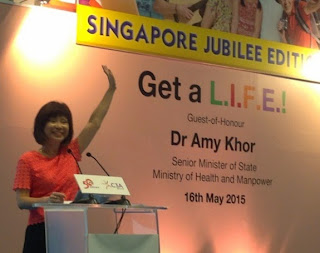
And that's not all. In her speech at the launch of 50plus Expo on 16 May, Senior Minister Dr Amy Khor announced that Singapore seniors can sign up for 400 free courses ranging from literature and dance to business and culinary skills. The Ministry of Health aims to encourage lifelong learning with this generous perk. 

For seniors that surely must be the icing on the cake to top off the year-long silver jubilee celebrations. No wonder the Singapore cheer turned into a deafening Singapore roar at Dr Khor's announcement.

So, that begs the question, what can our government offer us older Malaysians to make us happy and looking forward to our retirement years? We have given 30-40 of our prime years in the service of the country. Surely that must merit some recognition and appreciation?

We want an outdoor gym for seniors in every housing estate and public park where we can exercise

We don't want awards and titles, for they benefit only a few selected individuals, not the community. (By the way, Singaporeans from the PM to the man-in-the-street are addressed as Mr, and for the ladies, a plain Ms/Mdm.)

We don't want cash handouts which offer only short-term benefits to the needy. We want senior discounts on groceries, health supplements, fuel and meals, and other essentials.

Above all, we want to be accorded respect and dignity, not ignored or seen as unproductive and a burden to society

We certainly don't want empty pre-election promises of what the government can do, will do for us. We also don't want general references to what it plans to do for seniors. We want details, specifics and deadlines. And if the government doesn't deliver, we have the right to protest, to hold it accountable if it reneges on its word, and to withhold our vote if any of our under-performing ministers should stand for re-election. That's not a threat or a warning, but a straightforward case of cause and result.

So, what do we want?


Here's a short checklist to begin with for the relevant ministeries to take note of. In no particular order.


An impossible dream, or a soon-to-be reality?
If you click on any of the links above, you will find that SeniorsAloud have been making these proposals as far back as 2009. We will continue to voice our concerns till we are heard.

To give credit where credit is due, we appreciate the government's efforts in making public healthcare accessible and affordable to seniors. We welcome the discounts for seniors travelling on trains and buses. We also acknowledge the financial assistance given for funeral expenses (!) under the Mesra Usia Emas Scheme and other schemes.

With seniors making up 8.8% of the population and growing steadily, Malaysia is on its way to becoming an ageing nation in the next 10-15 years. UN defines a country as ageing when 7% of its population is aged 65 and above.

But these provisions are either limited, too slow in implementation, or if already available are not efficiently maintained or managed.

Each year when the budget is announced, we scan the papers looking for some tiny morsels of good news for seniors, only to be disappointed yet again. Last week, the PM announced details of the 11th Malaysia Plan for 2016-20. To date, we still have no clue what 'supporting active ageing for the elderly' involves, or how 'the government will address the needs of...the elderly'. (The Star 22/5/15)

How long do seniors in Malaysia have to wait before they hear these words from our ministers? Words are cheap, unless they are backed by prompt and effective action.

Our ministers are seniors themselves. Like us, they have elderly parents. One day they too will be elderly. Isn't it time they gave more attention to what the seniors and the elderly want?

Thursday, May 21, 2015

50PLUS EXPO REVISITED 2015

Last weekend 38 members from SeniorsAloud and University of the Third Age (U3A) Malaysia went on a 3-day joint trip to Singapore. Our main purpose was to visit the 50plus Expo 2015, but we also took in some sightseeing on Day 1, and a visit to Econ Medicare Centre and Nursing Home on Day 3. More of that later.

The trip was originally scheduled for 27-29 March. When Singapore's founding father Lee Kuan Yew passed away on 23 March, PM Lee Hsien Loong announced a 7-day national mourning period. As a result, the organizers Council for Third Age (C3A) and PICO had to postpone the expo to 15-17 May.
Our group (not all are in the photo) outside the expo hall on 16 May, 2015

If I remember correctly, the first 50plus Expo was held in 2009 to promote active ageing. Since then it has become a much anticipated annual event for older Singaporeans. I have visited it twice, in 2010 and 2011. It has grown bigger and better over the years. I had expected this year's Jubilee Edition to be even bigger and on a grander scale. But it didn't seem to be so. Perhaps the last minute change of date had affected the participation of some exhibitors and speakers. 

The Singapore Cheer team (in red) and the crowd waiting for the arrival of the Guest-of-Honour

Still, our group spent an enjoyable and fun day at the expo. There was much to see, do and learn as well, from health checks to food sampling, from games to entertainment on the stage. A pity, though, that the forum talks were held on a separate floor, and required pre-registration. Otherwise, many more of us would have attended the talks as the topics were of interest and relevance to seniors.

Senior Minister of State from the Ministry of Health and Manpower Dr Amy Khor, and Chairman of C3A Mrs Chua Foo Yong at the launch of 50plus Expo 2015. They sat on benches just like the rest of us. Exemplary!

In line with Singapore's Jubilee celebrations this year, Dr Khor announced that the Ministerial Committee on Ageing is offering 400 free courses for seniors as part of the SG50 Seniors package. You can imagine the boisterous response from the crowd. More reason for the Singapore Cheer!

Here is a small selection of photos taken at the expo. If you missed this year's expo, do make sure you visit it next year. It'll be worth your time. For now, do check out C3A's portal at http://www.c3a.org.sg/. It's packed with plenty of info and goodies for seniors.
.
My granddaughter would love this - creative arrangement of food to whet the appetite 
Always fun to play around with make-up for a new look. For ladies only? Don't men need grooming too? 
Cooking demo on how to make yummy crepes
This hobby is fast gaining popularity with seniors
These seniors are having fun learning to strum on the ukulele
 Puan Kasummah was interviewed by ST. This image appeared in Straits Times' online write-up about the expo.
Non-slip socks - great gift for grandma and grandpa
Queuing up to get the eyes tested
This might turn out to be the next big indoor board game for seniors
Portrait photography inclusive of styling by professionals, and you are ready for a cover shoot!
Waiting patiently for a talk on herbs and their benefits 
The ladies from People's Association getting ready to perform the cha-cha
Tapping into seniors as an excellent resource for community service
Spotted this foldable wheelchair at the expo. This young man and his mom were kind enough to give a demo.
Always great to meet up with Singapore friends like Eleanor Yap (left, back row) of Ageless Online and members of RSVP Singapore.
Meeting up with our counterpart U3A Singapore, led by their president Mr Goh Kim Seng (with orange lanyard)
With members of YAH (Young-At-Heart) College. 

On behalf of the group members, SeniorsAloud would like to thank C3A for the warm welcome given to us. A special note of appreciation to C3A's Ms Tan Si Ling and Ms Cheryl Ho for arranging the logistics for our visit, and to Ryan Lau for the guided tour and briefing.

It's time we had an expo for seniors in Kuala Lumpur. There have been several in the past, but nothing on the scale of 50plus Expo. Well, never too late. Will the private sector or the relevant government agencies take up the challenge?

Photo Credit:
Lily Fu
Koeh Siew Lim
Spencer
Eleanor Ong

Wednesday, May 13, 2015

SEX IN YOUR 60s - EASIER SAID THAN DONE

Some of you might have read the article 'Sex in your 60s' in The Sunday Star (3 May, 2015). A timely reminder that turning 60 does not necessarily mean we are on the decline physically, mentally and sexually. Far from it, according to Datuk Dr Nor Ashikin Mokhtar who penned the article.

A search on this blog will turn up a good number of earlier posts on this topic, some with images for 18+ viewing only :-)

I'm no sexologist or medical doctor, but we all know that any physical exercise done regularly over a period of time will improve one's overall health and well-being. This includes swimming, brisk walking and most definitely sexual intercourse too.

But as with most good advice, it is always easier said than done. There are many challenges that confront older couples in the bedroom besides the age-old complaint of - 'The mind is willing, but the body is not'.

Sure there are sexual aids available, from Viagra to lubricants, not to mention countless books and videos on sexual positions for the over 60s that take into account their physical limitations of arthritic joints, lower back pain, weak muscles, cramps, etcetera. These are just a few of the many physical ailments that plague older adults. This is the time when we wish we had laid the foundation of good health and physical fitness in our younger years.

There is also the question of relationship. Sexual intimacy goes hand in hand with a loving relationship between husband and wife. Unfortunately, many married couples have long lost that 'lovin feeling' for each other. Most continue to live under the same roof for convenience, but in separate beds or different rooms. Where there's no love, there's no will for physical proximity let alone sexual intimacy.

It takes two to tango, and to make whoopee. What if you are widowed, estranged or divorced? Or single? Your well-meaning friends will tell you to look for someone, preferably someone you fancy and who likes you too for the right reasons. Again, it's easier said than done.

You don't want any Tom, Dick and Hairy, or Moll, Peg and Suzie, do you? You are not that desperate, right? Not yet, anyway. You can't trust strangers who want to befriend you on social media or in bars and clubs. You need a mutual friend whom you can trust to make the introduction. Even then, it takes the right chemistry for two people who have just met to want to see each other again.

The field is very limited for older singles, especially for older women. By virtue of their longer life expectancy, single women far outnumber single men of the same age group. So while the good doctor advocates sex 'to improve heart health, reduce pain and depression, as well as increase relaxation and self-esteem', all of which contribute to healthy ageing, only the lucky ones get to enjoy these benefits. For the rest of us, it's gardening, line-dancing or running after the grandchildren to get our heart pumping and muscles working.

In Asian culture, conservative social norms dictate that seniors should behave and act their age. Translated, that means no sex, please, also no kissing, no hugging, at least not in public, and certainly not in front of the children. No lovey dovey, touchy feely display of affection, thank you. It's embarrassing, it's gross, it's offensive! Ah, wait till they get to be our age.

Personally I find it most heart-warming to see older couples holding hands while strolling, or sitting on the park bench with their arms around each other. Such open displays of affection in seniors are rare in Asian societies.


So to all those couples who are still very much in love after all these years, keep the flame of romance burning brightly and cuddle up in bed as often as you can. Appreciate each other for it is a joy to grow old together with the one you love. Not many are that blesssed.

Wednesday, April 8, 2015

EXPORTING GRANDMA AND GRANDPA

IS GRANDMA DESTINED FOR EXPORT TO JB?
by Janice Tai, Straits Times, April 9, 2015

LAST month, The Straits Times reported on the growing number of infirm Singaporeans who have been admitted to nursing homes in Johor Baru.

I was one of the reporters involved. Back home, I had a hypothetical discussion with my grandma on considering that as one of her retirement options.

Across the Causeway, you can get a room in a bungalow for half the price here. The elderly person can tend to the spacious garden outside instead of being cooped up in an eight-bedded ward reeking of stale air, or worse, urine.

Grandma, usually cheerful and mild-mannered, snapped in Hokkien: "I'd rather jump from this building than go there."

Despite her visceral objection, the fact of the matter is that more people in Singapore will soon need to have this discussion on nursing home care for elderly family members.

Sending Grandma to JB is, of course, not the default option.

But the economic case is compelling. Cheaper land, construction and labour costs in Malaysia can halve the cost of nursing home care.

Singapore is also short of nursing home beds, with an average waiting time of several months to be placed in a nursing home. That's because many homes here have been full for years and beds are freed up only when occupants die. All 401 beds at Peacehaven nursing home, for instance, have been occupied for at least the last 10 years.

Aged sick: The new export

THE idea of sending the old and sick to low-cost neighbouring countries may attract unease, as in 2009 when then Health Minister Khaw Boon Wan suffered much flak for suggesting it as an option.

But, in fact, the idea has taken off in other developed countries, where there is a shortage of qualified nurses and facilities amid soaring costs and a rapidly greying population.

But is this arrangement what our elderly folk and their caregivers really want?

My colleague and I spoke to three old people in JB nursing homes who thought they were still in Singapore. Dementia patients make up about half the elderly residents in local nursing homes.

But senior social worker Jasmine Wong at Hua Mei Centre for Successful Ageing says that dementia patients benefit from being in familiar, not strange, surroundings: "Persons with dementia retain old memories while struggling with recent events - so being in a familiar place helps relieve their anxiety and familial visits play an important part in that assurance."

Some research links family involvement and visits to better life satisfaction and early discharge back into the community.

So while nursing homes in JB may make sense as cheaper options, they are at best a niche solution for some. For one thing, their cost is not subsidised. Even a bed in a shared home in JB costs $600 a month - beyond the reach of poorer families.

For the masses in Singapore, there is no running away from the challenge of having affordable, quality nursing homes, especially as the population ages rapidly.

The cost of care

MOST nursing home patients in Singapore pay about $450 to $500 a month for a place, after government subsidies. Nursing home fees in Singapore range from $1,200 to $3,500 a month. This is before government subsidies of between 10 per cent and 75 per cent.

Nursing home operators cite rising labour and land costs as one reason for fee revisions. Econ, for example, raised fees by 10 per cent three years ago. This year, fees went up another 10 per cent, or between $220 and $440 a month. In that same period, wages went up 16 per cent.

What can be done to keep fees low?

SINCE 2012, the Health Ministry (MOH) has operated a new Build-Own-Lease (BOL) model where it builds and owns nursing homes and leases them to operators who have to bid to run them.

This puts downward pressure on fees because affordability is a key evaluation criterion in awarding such leases. Appointed operators are held to their proposed fees for the duration of the bid.

The BOL model also helps to reduce the capital outlay for operators. However, it will apply only to most of the 19 homes coming up over the next five years. There are 66 nursing homes now.

Another way is to incentivise existing operators to keep fees down in exchange for grants. This has worked to slow down fee increases in the childcare sector, where "anchor operators" have to satisfy fee requirements in order to get grants.

New approaches to care

BEYOND cost, there is much that can be done to raise quality. Chief executive of Lien Foundation Lee Poh Wah considers the state of nursing homes here dismal. "I view most of them as cold, clinical factories housing warm bodies which are awakened, cleaned and fed on a regimented schedule. There is an institutionalised absence of life and joy."

Single rooms are the norm rather than the exception in countries such as Australia, Japan and Britain. It is the reverse here, he said, with most people housed in six-bed to eight-bed wards.

To bring back the "home" aspect in the nursing home, the Lien Foundation is setting up a new $15 million building for elderly dementia patients next year.

Besides having single or twin rooms with en-suite toilets, the home will feature a rooftop garden, hair salon and grocery store. Residents can engage in social and recreational activities whenever they wish instead of adhering to fixed schedules.

More operators could develop care models that create homely environments where residents can choose their own schedules, not adhere strictly to regimented ones.

The time is right for a revolution in nursing home care.

One area crying out for a change is facilities for dementia patients. One in 10 of the older adults already has the brain disorder. But many nursing homes here are not purpose-built for them and they can often be seen wandering aimlessly along the corridors.

With a spike in the number of nursing homes, there should also be a way to assess the quality of homes, and publish these ratings, as the United States does.

Already, Singapore is one of the fastest-ageing countries in the world. As of last June, there were more than 430,000 people in Singapore aged 65 and above. That is a whopping 100,000 more elderly folk than just four years earlier.

The numbers are likely to rise to nearly one million by 2030.

It is clearly not feasible to think about exporting Singapore's elderly en masse to low-cost neighbouring towns.

In the end, sending Grandma to JB is not the best solution to the issue of providing aged care.

jantai@sph.com.sg

(The full article is available only to subscribers of Straits Times. Get a copy today or subscribe.)

Wednesday, April 1, 2015

TIME WE HAD A SENIOR PRIVILEGE CARD


For Malaysians living in Malaysia, the Goods and Services Tax (GST) comes into effect today - 1 April 2015. This is not an April Fool joke. It's for real. Nothing can be harsher than the reality of struggling with limited financial resources to maintain the same lifestyle. It does not help that we also have a weak ringgit. A double whammy indeed for everyone, especially for retirees and pensioners. They will have to tighten their belts a notch or two.

The time is certainly right for the introduction of a senior privilege card. Senior citizens in countries like Australia and the USA have been using such cards for years. About time seniors in Malaysia had one too, and SeniorsAloud will continue to push for it.


The opportunity finally came in Oct 2014 when SeniorsAloud received an invitation to participate in the Social Impact Innovation Challenge, organized by Agensi Inovasi Malaysia (AIM), in the Prime Minister's Department.

Our team members Kamil and Lily attended a one-day workshop as part of the challenge. We were taught how to pitch ideas. We brainstormed a few potential ones and finally decided on a senior discount or privilege card as our entry in the Elderly Care category. We were told that the 12 finalists would receive RM50,000 plus RM25,000 seed money to kick-start their projects.


We worked hard and came up with a slide presentation which we had to submit to AIM through their crowd-sourcing platform Ureka. Before the deadline came up, we were informed that there was no need to submit the slides. A brief write-up about the project would suffice. To cut the story short, our entry was approved. But we never got the chance to move on to the next round where we could pitch our senior privilege card to the selection panel.

Anyway, rather than see our efforts go to waste, we are happy to share the slides here. We welcome feedback, if any.

Setting the context - why the need for a senior privilege card

We figured we would target the middle class as it was affected the most by the rising cost of living. The lower income groups were eligible for welfare packages and subsidies, but the middle class fell outside the ambit of government aid. 

Self-explanatory.
Presenting our objectives. Noble indeed, but perhaps too ambitious?
Identifying the groups that would benefit from a senior discount card. We imagined the long queues waiting to apply for our card, much like lining up to get the Rabbit card for seniors to travel on public transport at 50% off the regular fare.
Some of the many benefits cardholders would enjoy.

As an added bonus for cardholders, we would include free transportation to hospitals by volunteer drivers who would regard this as contributing to the community. Seniors helping seniors.

Phase One: How it works. Such services are already in operation overseas.

Two models to choose from should the project receive the green light. You will be surprised to know how difficult it is for an elderly person to visit the hospital on her own for a check-up or for treatment.

Ok, a little self-promotion here is necessary if you want to sell an idea or business proposition. Our Unique Selling Points.

Wouldn't you want to own one, and not leave home without it?

To be sure, we already have tons of discount cards, privilege cards and membership cards. But one specially for seniors? Some companies have been issuing such cards to seniors as part of their customer service. But how useful are the cards?

I have a privilege card from a pharmacy that is valid till 2017. I hardly ever use it. Why?
  • There are simply too many terms and conditions governing the use of the card.
  • The discount is small - usually 10%. 
  • The discount is applicable for a very limited range of items. 
  • It is valid only at outlets operated by the issuing company.

In other words, there is no ONE card that offers seniors a decent discount across a broad range of goods and services.

Isn't it time we had ONE?